Tuesday, 30 June 2020
Sunday, 31 May 2020
Wednesday, 19 February 2020
Li Yuan Chia
Chinese artist Li Yuan Chia lived in England, next to Hadrian’s Wall, for the last twenty-eight years of his life. The wall, built by the Roman Emperor Hadrian to keep out the ‘Picts’ (Scots) is in Britain’s north west, and known for its naturally beautiful Lake District National Park. This ideal location formed a retreat for Li, a place where he could think, create and begin the construction of his Museum and Art Gallery (the LYC Museum and Art Gallery). He died of cancer at the Eden Vale Hospice in Cumbria’s Carlisle, in 1994, and is buried in Lanercost cemetery just below his renovated farm house in the small village of Banks.
Born in 1929, in Hsu village, near Lu Shan, Kwangsi Province, China, Li was the survivor of an adoption which went sour and, at the age of ten, was passed around orphanages and schools for children of bereaved Nationalist officer-families, eventually gaining an education at a special school for the children of Chang Kai-shek’s officers in China, and in 1949 moved to Taiwan with the retreating ‘Nationalist’ forces from China. Two years later (1951) Li was able to attend the art education department of Taipei Normal College for teacher-training, in Taiwan, from which he graduated in 1955.
The next few years saw Li exhibiting his artworks at the 4th Bienal de São Paulo, in Brazil (1957) alongside artists from the Taiwanese Tung fang/ Ton Fan hua hui (‘Eight Great Outlaws’ group) Painting Group, one of Taiwan’s most significant avant-garde movements, founded in 1956, and who later exhibited in New York’s Mi Chou Gallery in January, 1960. We are reminded that….
“Artists in this group included Chen Tao-ming (Chen Daoming, 陳道明), Ho Kan (Huo Gang, 霍剛) (original name Huo Xuegang, 霍學剛), Hsiao Chin (Xiao Qin, 萧蕭勤), Hsiao Ming-hsien (Xiao Mingxian, 蕭明賢) (original name Xiao Long, 蕭龍), Hsia Yang (夏陽) (original name, Hsia Zuxiang夏祖湘), Li Yuan-chia (Li Yuanjia, 李元佳), Ouyang Wen-yuan (歐陽文苑), and Wu Hao (吳昊) (original name Wu Shilu, 吳世祿). These eight core members were often referred to as “The Eight Bandits” (Ba da xiang ma, 八大響馬) because of their rejection of artistic convention and of academic training.”
(McIntyre, Sophie. "Eastern Art Group (Tung fang/ Ton Fan hua hui)." The Routledge Encyclopedia of Modernism. : Taylor and Francis, 2016.)
The ‘Point’ or the ‘Dot’ represents the beginning and the end, seen in the Taoist ‘Yin/Yang (Taijitu) symbol as a white dot (a seed of white) against a black field while simultaneously a black dot is seen as a seed of black against a white field. In Buddhism (as in Hinduism) the Bindu (point or dot) relates to the concept of Śakti (or power) and is also known as the Ajna Chakra, a point of awakening or the ‘Third Eye’, and is the point where creation begins as in the centre dot in the mandala where the dot represents the seed of the cosmos. Li’s meditative dots were a by-product of these transcendent spiritualities, and his belief in the control of mind over brush, rather than the utilisation of accident.
Li, when referring to his concept of the distillation of Chinese calligraphic cosmology into a single ‘Cosmic Point’, said ‘In 1959 my first painting was a tiny black dot on a white square of canvas – nothing could be simpler than that.’ In essence it was Li’s preparedness for an encounter with like minds in the Italian ‘Punto’ (Point) movement.
In 1961 Li visited his dear friend Hsiao Chin (from the Tung Fang group), and went on to found a fresh art movement with him - Milan’s ‘Movimento Punto’ (the Point, International Art Movement, 1961). The Punto group was the only art international art movement, at the time, influenced by Asian Buddhist and Taoist philosophy, and became home to Chinese artists Hsiao Chin, Li Yuan-Chia, Huo Gang, Italian artists Antonio Calderara and Dadamaino (Eduarda Emilia Maino), and Japanese artist Azuma Kenjiro.
Li arrived in Britain in 1965, for an exhibition of his work at ‘Signals’ in London, where had been invited by David Medalla and Paul Keeler to participate in Soundings Two, an international survey of experimental art. Signals was founded in 1964 by artist David Medalla, Gustav Metzger and Marvello Salvadori, as an experimental gallery and a meeting place for young international artists including Mira Schendel, Heinz Mack, Lygia Clark, Carlos Cruz-Diez, Takis, Li Yuan Chia and others. A year later Li Yuan Chia exhibited in Signals 3 + 1, and stayed in Britain, with diversions to Spain visiting friends, until his death.
Since his death Li’s works have appeared in…..
Tate Modern: Display, London (2014)
'View-Point: A Retrospective Exhibition of Li-Yuan-chia,' Taipei Fine Arts Museum (2014)
'Li Yuan-chia,' Sotheby's S|2 Gallery, London (2017)
'Li Yuan-chia: Unique Photographs,' The Whitworth, Manchester, England, (2019)
The LYC Museum & Art Gallery and the Museum as Practice Conference, Manchester, (2019).
Book Review: A Feast of Serendib by Mary Anne Mohanraj
Sri Lankan American academic, novelist and story teller Mary Anne Mohanraj, author of numerous books of different flavours, now presents a visual and textural feast - ‘A Feast of Serendib’.
This appetising book is published by Mascot Books and printed, coincidently, here in Malaysia. The book’s informative and poignant illustrations are by Pamudu Tennakoon, and overall book design by Jeremy John Parker. Mary Anne Mohanraj’s ‘A Feast of Serendib’ is available through Amazon.
In this culinary/literary infusion, Mohanraj has laid out, cover to cover, some one hundred flavoursome recipes (over 270 plus pages) from an appetiser of Chili-Mango Cashews to a dessert of Tropical Fruit with Chili, Salt, and Lime. The recipes originated from recollections of her mother’s Sri Lankan superbly multifaceted cooking, collected more than a decade before. Mohanraj’s hard work, patience and diligence has paid off in the production of this elegantly designed, and most informative, volume of a rare cuisine.
The book’s title ‘Serendib’ is where the word serendipity derives. In Arabic/Persian, ‘Serendib’ means the Island of Rubies - that stunning isle which we now call Sri Lanka, or Lanka - the famous isle of the Hindu Ramayana (Sita and Rama’s love story). For others that punctuation of Indian sub-continent is Ceylon, wafting memories of tea.
My personal attachment to the island of Sri Lanka had began in 2004. I carried a broken heart to heal from India’s Chennai to the majestically spiritual island of Sri Lanka. Previously I had foolishly engaged in a short lived romance with a Keralan Singaporean (no Sita/Rama story), which had sadly gone sour. On the way back to England I took the opportunity to heal my aching heart in Sri Lanka. I had looked forward to the distinct pleasure of spending a few days sheltering beneath wind cooled banana fronds on Sri Lanka’s west coast, near the capital, Colombo with a hankering for authentic ‘Hoppers’.
As I was on an ancient island known to be blessed with a most diverse of cuisines from Sinhalese and Tamil traditions; from the cuisines of Arabia, from the Portuguese, the Dutch, British etc., it seemed pertinent to discover more about the food that I had come to love back in the amiable homes of British friends of Sri Lankan descent.
Since the 1990s I had developed a taste for the aforementioned Sri Lankan ‘Hoppers’ (those delightfully thin fermented batter ‘pancakes’ with the soft spongy middle used for absorbing coconut milk and jaggery, called appams in Indian, page 203). Likewise, the sheer delight of the thin rice noodle ‘String Hoppers’ (Idiyappam, or rice flour dough steamed noodles, also called putu mayam in Malaysian) which had captured my gastronomic imagination. Incidentally, hoppers and string hoppers are excellent with curries, especially when eaten using your fingers for an authentic experience and an enhanced taste. I suggest that you follow the recipes lay betwixt the pages of ‘A Feast of Serendib’, and thereby discover for yourself. I might also imply that the simplicity of a Sri Lankan ‘Fish Curry’ (Meen Kari, mentioned on page 109) with hopper/string hopper or rice is similarly difficult to resist.
Mary Anne Mohanraj’s delicious book brings all those righteous tastes back to me. Mohanraj’s ‘A Feast of Serendib’ feeds my inner craving for Sri Lankan cuisine, and those items of Indian cuisine which have slipped into it, like ‘Chai’ (Indian tea) and ‘Falooda’ (which is somewhere between a drink and a dessert containing milk and sweet basil seeds and sometimes rose water and ice cream), and may just have an Iranian connection. Reading Mohanraj’s book, and gawping at the images and recipes makes me wish that I could just up sticks once more and travel back to that resplendent island, and again savour its distinctive fare.
Thank you Mary Anne Mohanraj, for the nostalgia.
Celeste Comes in Colours
![]() |
| Batanguena in Spontanrealismus, 2018 |
She comes in colours ev’rywhere;
She combs her hair
She's like a rainbow
Coming colours in the air
Oh, everywhere
She comes in colours
Keith Richards, Mick Jagger, from the song She’s a Rainbow, on Their Satanic Majesties Request Album, 1967
She combs her hair
She's like a rainbow
Coming colours in the air
Oh, everywhere
She comes in colours
Keith Richards, Mick Jagger, from the song She’s a Rainbow, on Their Satanic Majesties Request Album, 1967
Celeste Lecaroz (Celeste Lecaroz - Aceron y Salud) hit the ground running with her first solo exhibition, in May 2018, titled “Lecaroz Spontanrealismus”, after having been painting for only two years. Lecaroz developed her artwork in a style which she has referred to as “Lecaroz Spontanrealismus” (or Lecaroz Spontaneous Realism), styled after the work of ‘Spontaneous Realism’ by the neo-Fauve Austrian artist Voka. Voka describes "Every painting is an impulsive challenge that starts with a first idea and ends with the final brush stroke, and each brush stroke decides over victory or defeat.” Lacaroz, like Voka and the “Les Fauves” (The Fauves) before him, has a distinct “dialogue with colours.” For she creates her vivid imagery full of gusto, verve and robust colour.
In the early 1900s, Fauves’ initiators were Henri Matisse, André Derain, Raoul Dufy, Georges Rouault, Maurice de Vlaminck, Albert Marquet, Kees Van Dongen, and Othon Friesz. The Fauves, meaning the ‘Wild Beasts’, had been so named by the French art critic Louis Vauxcelles due to the shocking non-natural colouration of their canvases. Incidently The Fauves are believed to be the first real ‘Modernist’ painters and leaders of avant-garde art, due to their use of colour as expression rather than mimesis.
Fauve Henri Matisse had written (in ‘Notes d'un peintre’ in La Grande Revue, Paris, 25 December 1908) that…
“Expression, for me, does not reside in passions glowing in a human face or
manifested by violent movement. The entire arrangement of my picture is
expressive: the place occupied by the figures, the empty spaces around them,
the proportions, everything has its share. Composition is the art of arranging
in a decorative manner the diverse elements at the painter's command to express
his feelings. In a picture every part will be visible and will play its appointed
role, whether it be principal or secondary. Everything that is not useful in the
picture is, it follows, harmful. A work of art must be harmonious in its entirety:
any superfluous detail would replace some other essential detail in the mind of
· the spectator.”
Although Celeste’s Filipino artistic predecessor, Victorio Edades (1895 to 1985), has been proclaimed as the “Father of Philippine Modern Art”, it is Fernando Amorsolo y Cueto (1982 to 1972) who brought the sunshine into Philippine painting. He coloured rural imagery full of Post-Impressionist lightness, typified by his paintings ‘Workers in the Field’ (1926) and ’The Tinikling’ (1946), whereas Edades was inclined to more sombre representations. It is Fernando Amorsolo y Cueto’s tradition of colour in the art of The Philippines, which re-emerges with the flamboyant imagery of Celeste Lecaroz.
Henri Matisse also wrote (again from ‘Notes’) that….
“The chief function of colour should be to serve expression as well as possible. I put down my tones without a preconceived plan…..I cannot copy nature in a servile way; I am forced to interpret nature and submit it to the spirit of the picture. From the relationship I have found in all the tones
there must result a living harmony of colours, a harmony analogous to that of a musical composition.
Jay Maisel (in his book “Light, Gesture & Color”) reminds us that…
“Color is seductive. It changes as it interacts with other colors, it changes because of the light falling upon it, and it changes as it becomes larger in size. This last aspect can be seen in the tears and rage of anyone who has chosen a color based on a two-inch sample and painted an entire room in it.”
From the Impressionist’s (1860 onward) with their scientific approach to colour, to Georges Seurat and Paul Signac’s Pointillism (mid 1880s) and those artists who have been deemed Post-Impressionist all were developing fresh ways of painting the art subject. Colour was an integral part of this. Artists began to move away from the colours they perceived directly from the subject, away from what might be noted as a cold clear naturalism, and trying desperately to emulate the colours they thought they saw before them, to investing feeling, and emotion, into the equation.
This led to emotive exploration by a group so named “Les Nabis” (or ‘The Prophets’ ,1880 to 1900s) who worked towards a stylised flatness of colour, often using decorative elements as seen in Paul Élie Ranson’s painting ‘Nu se coiffant au bord de l’étang’ (1897), a variation on the artistic ‘Bathers’ meme. Post-Impressionists (from 1886 onwards) like Vincent van Gogh, Paul Gauguin and Alfred Wolmark worked with heightened colouration and emotive form, as witnessed in Gauguin’s ‘Vision after Sermon (Jacob Wrestling)’ (1888), Van Gogh’s ‘The Mulberry Tree’ (1889) and Wolmark’s ‘Decorative Still Life’ (1911).
A flamboyant use of colour had been developing in the West which eventuated in the aforementioned works of those painterly wild beasts “Les Fauves” (1905 to 1910), and a wonderful quote from Henri Matisse “...when I put down a green, it doesn't mean grass; and when I put down a blue, it doesn't mean the sky.” Colour, in a sense, had been set free from the subject and enchained only by imagination and emotion, aided and abetted by science and new ways of manufacturing brighter tube paint pigments.
Further to this, Nathalia Brodskaïa, in her book ‘The Fauves’ (1995, pp30) writes…
“Their painting [the Fauves] brought out the very thing inherent in the medium: the capacity of oil paints to set in pastose clots or to spread in a thin layer making it possible for one colour to penetrate into another without losing its purity and resonance in the process. They were united by a genuine, feverish delight in the possibilities offered by a bare canvas and tubes of oil paint….”
The advent of Otto Röhm creating acrylic resin, in the 1930s, later heralded the notion of acrylic paint, and changed the way painters painted. Artists such as David Hockney, Roy Lichenstein and Andy Warhol, in the 1960s, championed acrylic paint because of its perceived diversity and quick drying properties. Since those days the quality of acrylic paints has improved no end, as has the initially limited colour range. New testing standards suggest that the new acrylic paints will be lightfast between 50 and 100 years.
Acrylic paints enable Celeste Lecaroz to rapidly capture her images without having to wait inordinate amounts of time before applying fresh colours. She is able to react in a spontaneous manner, and create in a figurative, some might say realistic, fashion. Hence her reflection of Voka’s ‘Spontaneous Realism’ while simultaneously giving an art historical nod to her predecessors, Filipino and foreign.
Thursday, 19 September 2019
MIA sculptureatwork
I was overjoyed to receive an invitation to attend the annual MIA (Malaysian Institute of Art) gathering, this time held at the creative hub of Sculptureatwork, Malaysia’s leading base for public sculptures.
I had been tinkering with the shell of my new three storey home. The basic structure of the house was there, but fixtures and fittings were, largely, absent. There were no kitchen units for either of my wet or dry kitchens, no light or fan fittings, with wires left where they and the aircon units should be - and in the most awkward of places too. So I had a lot to do.
With the aid of Bangladeshi workers (don’t ask) I had been getting familiar with making things out of concrete and experimenting with lighting, wall hanging and shifting electrical sockets (and plumbing) throughout the house, from where the builders put them to where I wanted them. It has been some great task, and has been going on for some months.
I wanted to input a sense of Walter Gropius’s ‘Modern’ or some sort of contemporary aspect into the house. Hence the concrete. Yes I know that concrete dates back to the Romans (200 BC) , and so is hardly new, but one Joseph Aspdin (1824) invented the regularised ‘Portland’ cement enabling widespread use of cement in home construction in England and France between 1850 and 1880, especially by Frenchman Francois Coignet. But, increasingly, raw concrete is being used in contemporary houses, as is the concept of raw bricks and exposed pipes (or so I am led to believe from such magazines as Interior Design Yearbook 2019, and Living Etc. UK 2019).
It was a sheer delight then, to be ushered into the building (which is home to Sculptureatwork - yes, all one word) and were greeted by company CEO Soon Yee Ling. Soon Yee Ling, if you may remember was (back in 2008) responsible for mini sculptures of Penang businesses, at the time of its Unesco world heritage site listing, as well as ‘Voices From the People’ (George Town Penang - a collection of 52 flat, iron rod made caricatures placed on its historic streets). Sculptureatwork has made myriad public sculptures ever since, including the bright red ladies (The Past and Present) and silver leaping lady (Jump for Joy) at Puchong’s mini-mall Setia Walk.
Inside the studio and office complex at Sculptureatwork, the first items to grab my attention were the concrete walls, concrete floor and the exposed concrete beams/pillars. The seating varied from white painted ‘chicken’ cages (which were either left to resemble themselves, or re-constructed to resemble chairs) to seats made from wooden railway ‘sleepers’. Some of the walls were adorned by some small sculptures (Maquette?), others by some of the miniatures used for the George Town event. Upstairs, cut railway sleepers had been utilised as kitchen ‘breakfast bar’ stools in one wide area focusing upon a very lifelike hippopotamus (2009) statue, mounted by three metal black ‘cartoon’ birds.
There, inside that building, the serious business of contemporaneity in design rubbed shoulders with humour and humorous juxtaposition (such as the horse attempting to climb off the upstairs balcony, or the grossly enlarged star anise [Illicium verum] spice made of bronze casting, and topped with glass to form a coffee book table). Elsewhere, up concrete (yes more concrete) stairs which led to nowhere, a Chinese styled birdcage sat with its door open. Miniature figures were posed as if entering the cage, while others were already inside. Is this a comment on Marilyn Frye’s short essay on ‘Oppression” I wonder.
Outside, along a broad concrete patio, both wooden and concrete benches invited visitors to rest. To one side, what appeared to be a life-size, yet cartoon, bronze bear (maybe Kipling’s Baloo) seemed to be motionlessly hurrying toward a sculpture of a white stag (deer) with magnificent antlers. Around the corner, as if planted and growing, was a herd of other white deer, some seated while others stood lookout for the static bear, or stray visitors such as ourselves. Further along, artwork which had been designed by legendary Malaysian cartoonist Datuk Mohd Nor Khalid (Lat), and had been placed throughout Kuala Lumpur city centre, lounged as a tribute to the cartoonist and to the company which made the sculptural images.
It was a sheer delight to witness the contemporary overt plumbing in the washrooms, with joints and naked pipes on display in an ‘industrial’ look with bends and joints appearing less humble and more artistic, but not in any Melamid way (reference to the contemporary artist Alexander Melamid, painter of The Art of Plumbing, including ‘Form-N-Fit 1-1/2 Flanged Tailpiece’, ‘Large Drain Cleansing Bladder’, and ‘The No Clog Drain, Permaflow’).
Ultimately I came away full of awe for the company Sculptureatwork, full of praise for Soon Yee Ling and his studio teams and with a multitude of ideas for the new house. My visit had improved my thinking about contemporary interior design but, sadly, not the finances to put much of it into practice.
Monday, 26 August 2019
Khmer sisters doing it for themselves
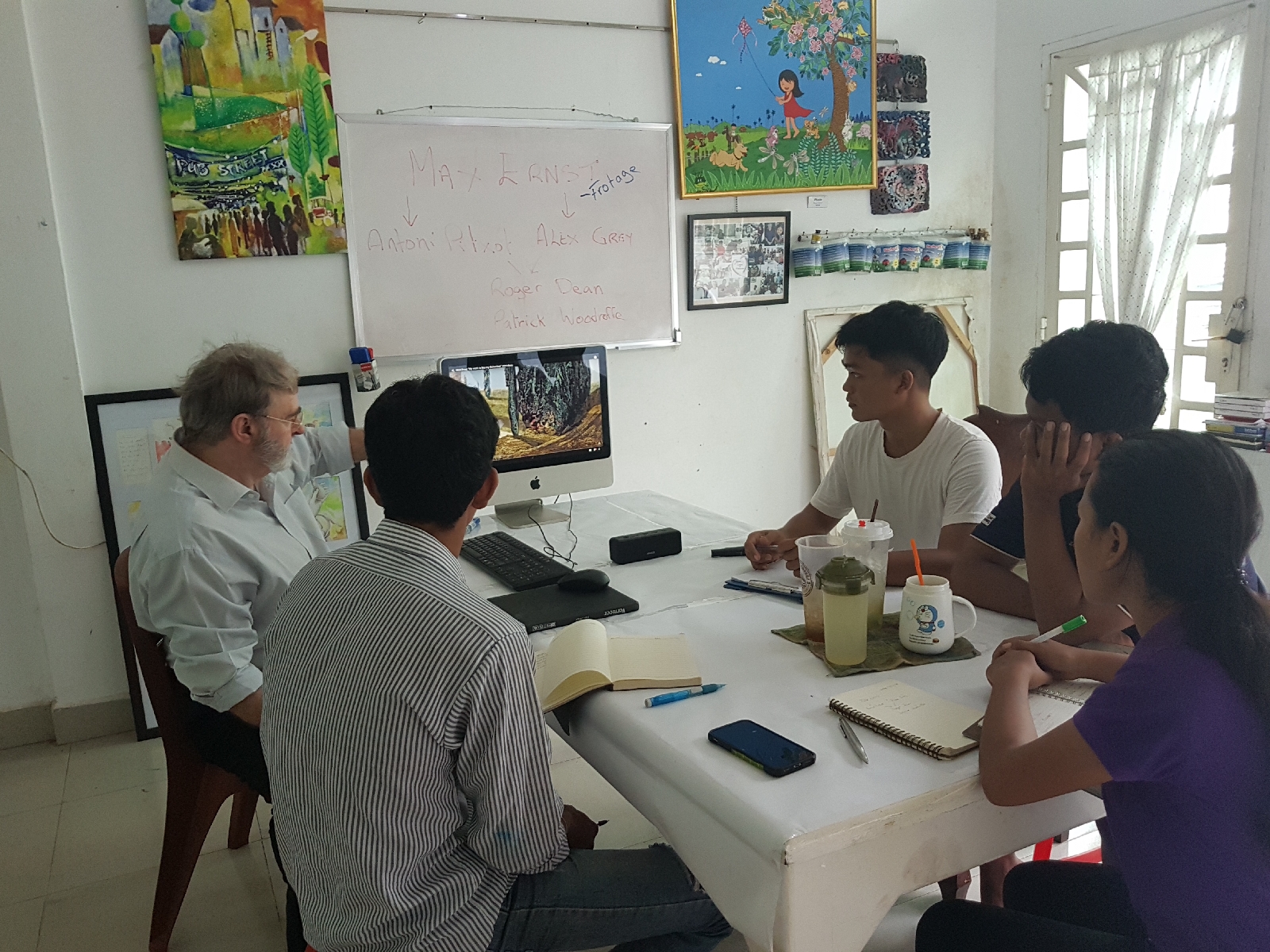
Sor Sophany and Sor Sophanin are twin Khmer (Cambodian) sisters (kaunophloh dauchaknea), born 1989, and are now thirty. They were born in, and live in, the northern town of Siem Reap, in Cambodia. Since a very early age the sisters have had an acute interest in creativity, sometimes it has spilled over to the kind of physical activity found in martial arts, in their case ‘Bokator’ - an ancient Khmer for of both offence and defence, or performing with traditional Khmer instruments, and frequently experimenting with painting.
On this day, in Siem Reap, it had rained. Small pools of water in the fields had been growing larger as we descended towards Siem Reap International Airport. The shudder of touch-down invigorated the usual clamour to disembark, the rush to obtain visas, clear immigration/customs and to finally greet various drivers, friend, relatives or representatives of various lodgings.
I was alone, at Ellen’s Cafe (Samdech Tep Vong Road Mondul 1 Village), and had just read, online, an article in the Phnom Penh Post revealing Phany and Phanin’s passionate interests in art, and martial arts. The article ‘The twins aspiring to empower kids, women through art, fighting’, by Pann Rethea, spoke of female empowerment, and aspects of confidence boosting in a male dominated Khmer society. The Khmer twins (Sor Sophany and Sor Sophanin) have chosen art and Khmer culture, as standpoints.
Phany and Phanin, together, have grown into a profound love for art. Phany has risen too become manager of one art charity - Colors of Cambodia, where she and her sister studied, while her sister Phanin has been a manager at Artisans Angkor, a Cambodian social business reviving traditional Khmer craftsmanship, in Siem Reap.This love of art and culture has been facilitated by Khmer art teachers who, themselves, were taught in Cambodia’s northern town, Battambang, at Phare Ponleu Selpak, a non-profit Cambodian association improving the lives of children, young adults, and their families through art. In Siem Reap, aid towards Colors of Cambodia has materialised from as far afield as the US of A, with artists like Michigan born Julia Haw, also from Singapore with Foo Kwee Horng enabling and empowering young Khmer artists.
Over time, the Cambodian twin sisters (Phany and Phanin) have become prominent in a freshly emerging Cambodian Surrealist art scene. The sisters blend their knowledge of Cambodian culture with Western painting techniques, including oil, acrylic and water colours as well as the use of coloured pencils, or pastels, to produce stunningly original works of art. The twins’ distinct artworks have spoken of an emerging Khmer feminism, of female empowerment and of their happy/sad lives as identical twin sisters in a Cambodia still reaching towards modernity, especially within the realms of gender relations.
‘A Storyscape in Dance’ is a predominately yellow and blue painting by Phany. In Cambodia, yellow is a symbol of happiness, of friendship, of enthusiasm, of luxury, of success, and of pride. Two figures, in yellow, dominate the picture. The two figures are standing amidst a washed out blue (the colour of royalty, of freedom) and are practically identical. Their hands are attached, left hand to right hand as they face inwards, into the painting, perhaps divining their futures. Similar to many other paintings created by either one of the twins, the concept of their togetherness, of the special pride they hold for their nature as twins, often dominates. Though fiercely proud of their Khmer heritage, the twins are equally proud of their uniqueness as twins.
In her painting ‘Massive Dream Girls’, Phany has drawn from the energy of an organic Surrealism otherwise seen in the British Surrealist Desmond Morris and the Catalan Surrealist Juan Miro’s works. In that painting Phany has taken her dreamlike imagination to its limit. She metamorphoses herself and her sister into a quasi erotic synthesis of potent, yet unidentifiable, organic forms resembling a fluidity of droplets and globular forms.
Other paintings ease the more surreal elements into the background, while bringing reflections of Khmer culture to the fore. This can be witnessed in Phany’s painting ‘Kenor’*. In ‘Kenor’ the female figure is an ‘Apsara’** like being. Phany explains that Khmer Apsaras cannot fly, unlike Indian apsaras who are messengers of the gods. Phany’s Khmer Kenor is a demigod-like mythical being with an ornamental crown of gold. The Khmer people believe that the Kenor (Neang Kenor) are half-women, half-bird deities living in the heavens. In modernity, Kenor are frequently represented through Khmer dance, as are apsaras. A Kenor also features in her sister Phanin’s painting, where a Kenor is trying to help an angel who has been chained to a block. A radiant sun shines on the empathy the Kenor shares with the trapped angel. Angles, Apsara and Kenor are metaphorically ‘sisters’ within Khmer mythos, thus symbolically emphasising the closeness shared by the Khmer twins. Another image (by Phanin) has a Kenor embracing a naked Angel. They sit, the Angel is resigned to the comfort her ‘sister’ mystical being exudes. The Kenor smiles a peaceful smile.
In the upstairs art room of one Cambodian art charity, next to twin wall-mounted Khmer Trou Ou (musical instruments-often played by Phany and her sister) hangs another painting by Phany. This canvas features stone steps, a ladder in perspective and before it a representation of the twins, as apsaras. The twin on the right ((dressed in pink) faces the ladder, on her long black hair is an apsara crown. She has her arm entangled with her sister (in green) who faces the onlooker with a paper mask over her face. The female figures are framed in the foreground by large standing pillars. The two women, one looking forward, but masked, and the other looking towards the ladder, reveal a dichotomy besides their being identical twins, the individuality of their characters and the obverse and reverse nature of the painting’s figures. Two ladders are traditionally used to enter Khmer houses, for only the solidity of temples had stone steps. Houses were raised to be away from annual flood waters (May to November). Can the sisters climb the ladder while one is held in thrall by those who view. Can they disentangle themselves to lead separate lives. It is a dilemma. Phanin’s surreal painting of Cambodian flowers dominates the wall opposite.
In more recent paintings, Phany experiments with a change of style. Gone is the blended smoothness of the earlier surreal work. This is ejected in favour of a more textual approach to her painting. Phany’s background subject matter becomes reminiscent of the Italian proto-surrealist Giorgio de Chirico, but with a more highly textured foreground, as if revealing the angst of her subject within the depth of the paint, as well as in the painting itself.
Gradually Phany moves towards a painterly magical realism. She maintains colours from previous paintings but, in places, interjects this with a stark expressionism. One such oil painting, her latest - ‘Endless hope’, is dominated by her surreal colouration in the mid and background, but the foreground features a highly textured, practically expressionistic, figure of a young man drinking from a bottle of water. He stands next to a school bench. Phany explains that this is a scene she witnessed when she was younger. The water-bottle is old, the water brackish. The young, poor, student is ashamed of his ageing water bottle and hides it from view when he can. He grows, remembering his poverty. It is a human reenactment of the story of the lotus. The lotus, revered in Cambodian Buddhism, emerges from its humble beginnings in a lake’s mud. It strives and reaches into the sunlight, then blossoms. Many varieties of lotus are both wild, and cultivated, across Cambodia.
One exuberant painting, titled ‘A Little Peace’ sees Phany furthering her new style. A jewell faceted head, in purple, sits on a body half blue and half pink, as if the notion of ‘twin’ becomes merged into one being. A Buddha -like figure demonstrates a ‘Mudah’ or significant Buddhist hand gesture. Perhaps a blessing or protection (Abhaya). In the painting elements of Expressionism meet fragments of Cubism and organic Surrealism in a canvas dedicated to peace, with intimations of former horrors. This is achieved, subtly, through her stylistic melange which surprises and delights at one and the same time.
Phany’s sister Phanin has also experimented with Expressionism and a fantasy based Surrealism. ‘The hurt want what want’ reflects all the angst of Norwegian Edvard Much’s ‘The scream’. Phanin’s tortured figure is in red, while the background is a moody blue.
While we marvel at Cambodia’s painting twins Phany and Phanin, there are twin sisters painting in Britain too. The British Singh Twins (Amrit Kaur Singh and Rabindra Kaur Singh), who were born in London of Indian decent, use traditional techniques seen in Indian miniature painting, but in a contemporary way. Their vibrant works have been seen in galleries across the world, and one can only hope that the same fate awaits the Khmer twins Phany and Phanin.
A Kenor is a mythical female dancer with a body half-human and half-bird.
**According to the Oxford Dictionary - An Apsara is a type of female spirit of the clouds and waters in Hindu and Buddhist culture. They figure prominently in the sculpture, dance, literature and painting of many South Asian and Southeast Asian cultures.
Subscribe to:
Posts (Atom)