Wednesday, 26 August 2015

Dr. Cheah Thien Soong’s ‘Lush Forest’


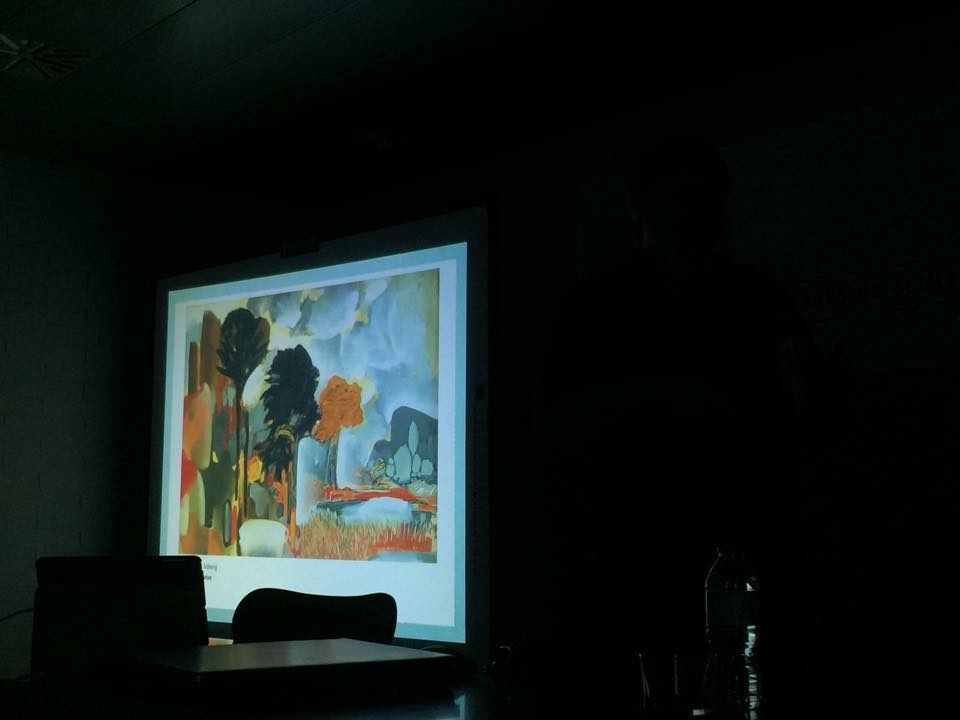
There is a refreshing, unforced, naturalness and homogeneity to the three panelled ink and brush work 'Lush Forest' by Dr. Cheah Thien Soong. Three lengths of Xuan (Shuen) paper, made in the Chinese province of Anhui from natural sandal wood and bamboo fibres, comprise the artist’s semi-abstract artwork. The artist’s bamboo constructed brushes wield a variety of animal hairs for a multitude of distinctive strokes, his black ink deriving from soot, and colours originating from minerals, or other naturally occurring matter.

'Lush Forest' is less graphic than many of the ink brush works Dr. Cheah has created in the recent past. Gone are the imposing tree scenes, the angular counterpoints of black and white and the representative, anthropomorphic waterhens. Instead, Dr. Cheah reveals a soft, yet mysterious, ink and colour wash of a jungle vista. The idea of sequential movement remains, as in sequential art (or comics), in the use of three strips of paper hung side by side, which may be read as movement in comic panels. It is a movement into the notion of ‘Lush Forest’, which in Malaysia may be read as "Jungle", both literal and figurative.

We are not subjected to the wilds of Mungo Park's almost impenetrable jungle (Travels in the Interior Districts of Africa), nor are we lectured by moral laden Mowgli inhabited Indian jungles (Kipling's Jungle Books). But we are guided into a land of South East Asian jungle, noted by Claudius Ptolemy and traversed by Isabella Bird, which is known as the Golden Chersonese. In many respects these three paper strips represent a very real jungle seen, quite literally, at the end of the road that Dr. Cheah’s house inhabits. For he lives on the fringes of a still verdant, equatorial, Kuala Lumpur.

I have mentioned (above) that ’Lush Forest' by Dr. Cheah is a semi-abstract work. Although trained in both Xie He's six principle Classical (vitality, use of brush, depicting form, application of colour, arrangement and observation) and four part Literati (character, knowledge, talent, and thought) influenced styles of Chinese ink brush painting (at the Nanyang Academy of Fine Art, in Singapore) Dr. Cheah soon found that his art school teachers more favoured the freer styles of Chinese Literati painting. 

While honouring the great landscape painter Dong Qi-chang, ‘Lush Forest’ becomes a fine example of a new Literati painting, resembling those paintings ever edging towards the abstraction of the Modern Literati movement (China) - a movement emanating from the late 1970s, and forever evolving, perpetuating the Literati essence. Dr. Cheah’s ‘Lush Forest’ is no straightforward Chinese ink and brush painting. Though there may be traditional Chinese symbolism infused in the skill and knowledge of the painter, the images are fine examples of a style indigenous to Malaysia/Singapore - called the Nanyang (or Southern Seas) style, in which Chinese methods and materials are fused with Western concepts and visual iconographies native to the Malay Peninsular and Singapore, e.g. the jungle, as opposed to a gentler Chinese forest.

In this three paper abstraction, Dr. Cheah renders detail enough to hold us to the idea of a mysterious, green, forested land, while simultaneously producing an ephemeral wispiness which holds our imaginations in rapture. ‘Lush Forest’ transports us into jungles real and unreal, jungles of the spirit, philosophical jungles and jungles of our imagination. Layer upon layer of watery brush strokes lead us into an unfathomably complex jungle. There is visual denseness, wrought by intense and deft brushwork, leading to a cloud-like airiness at the top of each picture. It is as if the jungle dissipates into a haze, diluted by keen perspective, as we watch. 

Balancing the brush-stroked black ink density is a small white patch at the bottom, centre, of each paper panel. The clarity of the white patch becomes our entrance to the jungle, and the beginning of our journey. The white is, perhaps, the beginning of Lao Tzu’s ‘Tao’ (path or way) guiding us through the tangle and misdirections of human existence and through into spiritual essence . Through the Forest whispers the Ch’i breath, universal Yin and Yang.

The ancient Chinese poet Li Po (Li Bai) has written Why I Make My home in the Mountain forest

You ask O why I’ve chosen to live in the mountains green;
I smile without replying, my heart sedate, serene.
Peach flowers on rivulets gambol, then ramble out of sight; ’tis
Heaven and earth with a difference, not of the world we’d been.

(Translated by Andrew W.F. Wong - Huang Hongfa, 2008) 

李白:  山中問答(答俗人)


問余何事(意)棲碧山
笑而不答心自閒
桃花流水杳然去
別有天地非人間

In Dr. Cheah’s three part painting ‘Lush Forest’ we engage our imagination, we chose to make our home, if however temporarily, in that painted ‘forest’, enticed by the artist’s brush work. We observe real and imagined jungle landscapes, paths, calming skies. We hear whispering echoes of an ancient poetry, we sense, in our now heightened imagination, somewhere far where gushing waterfalls spill liquid heaven to taunt tropical jungle fern, and age old eroded rock alike. We feel, simultaneously, the solitude and togetherness of all things, us included, within those ink created equatorial forests on paper created by this master Dr. Cheah Thien Soong.


Dr. Cheah Thien Soong: Harmonious Symphonies


Dr. Cheah Thien Soong’s Harmonious Symphonies (ink and wash on Xuan zhi, 132 by 246 centimetres), magnificently draws contrast between passages of intense, dense, black ink (Mo) and lighter, airier passages of light blue and white, dappled by a fawn brown. The background consists of a seemingly dark, doom laden or foreboding set of mountains, skilfully layered to reveal a jagged multiple mountain range, perhaps Malaysia’s own divisive Titiwangsa, or some Asian Tolkienesque Mordor. It is perhaps dusk, as red/pink streaks the sky amidst hesitant clouds. The dense mountainous background appears to offer little hope, soot black, imposing, whereas the fore and mid grounds slice through the depressive mountains bringing not just hope, but joy and a collective, wondrous, harmony.

It is at dawn and dusk when the ubiquitous light and dark coloured waterhens gather. During the day they are mostly solitary figures, foraging, like domestic hens (from which similarity they draw their names), pecking amidst bushes and the sand around the margins of mining pool lakes, or skirting the dampened rural padi. But at either extreme of the day the Amaurornis Phoenicurus waterhens gather, in communal groups, and socialise, cackling, noisily.

Dr. Cheah, as the painting’s title might suggest, presents his viewers with an eight foot long, Chinese ink brush paper painting of pastural, communal hope, harmony and perhaps a little expectancy too. His common, and plentiful, waterhens are gathered across the bottom of a painting which deftly manipulates its audience’s perspective, much in the manner of a Cubist painting. Jean Metzinger had written (of the Cubists) that they had “uprooted the prejudice that commanded the painter to remain motionless in front of the object, at a fixed distance”. . Curiously, Metzinger in a different article (On Cubism,1912) also praises the spatiality of Chinese painting.… “Do not the Chinese painters evoke space, despite their strong partiality for divergence?” Dr. Cheah Thien Soong both evokes space, in the traditional Chinese way, but also presents varying view points to wield his deft narrative, in ways hinted at by early twentieth century Cubism.

In Harmonious Symphonies the bleak black background is practically flat, yet Dr. Cheah has arranged a positive space of trees to form the foreground. Those trees shoot through the painting to divide those seemingly impenetrable mounting into two halves, the tops of the trees perspectively guide the viewer’s eyes through the painting, and a light blue sky space forms the middle third.

We see the trees as if we are those birds, those waterfowl, gazing from the bottom of the tree trunks, looking upward into the trees’ distance, into their far away branches and towards the serenely blue sky, just as the waterhens might. For a moment, there is a curious interconnectedness between artist and viewer as, momentarily, we become the waterhens and they become us, symbols of us and for us, a benign anthropomorphism perhaps in which the waterhens speak for us, see for us and feel for us. The birds look upwards, in expectation or is it in praise, their sharp beaks pointing to other birds, far off, flying freely in wedged flocks. In the trees, and on ledges, the fluffy, rotund, waterhen young are safe, above ground, protected from predators. The cackle of waterhens has stopped, for a moment’s prayer. The new symphony is a symphony of reverential silence, even perhaps in awe at the free birds distantly flying home, and it is an harmonious one, shared by the waterhen populace. 

To the right hand side of the painting, another reverence takes place. A small grouping of waterhens, beaks raised, look up at outlined lotus flowers. To one side of those flowers, on a ledge, sit three waterhen young, one lotus flower bends towards them, perhaps giving grace in its Buddhist symbolism. In the distance, as our eyes follow the positive space giving us the trunk of the tree, another flock of birds fly, almost like a dart, into the distance. On another ledge, opposite to the lotus graced chicks, a couple follow the free flying birds with their beaks, by them are reed like bamboo twigs symbolising perseverance.


There is communal spirit, reverence, growth, safety, harmony, hope and expectation in a painting which constantly disrupts the audience’s view point, and in so doing presents many surprises and delights as the eye follows Dr. Cheah’s lead from the birds, through the trees to the blue sky, and falls back to gorge on the detailed narrative provided by those waterhens. In many senses it is a sequential narrative, akin to the ‘framing’ in comic books. The ‘story’ is told in ‘comic panels’, spaces, trunks of trees, our eyes are encouraged to ‘read’ the painting as you would a comic book. There is even text. But Dr. Cheah uses hand drawn text both as written communication (poem) and as pictorial elements, much in the way the American comic artist Will Eisner might have, to bind text within a complex, engaging, visual narrative.

Monday, 22 June 2015

Tastes Surrealists


In Summer, 2015, I made my way back to George Owell and Ernest Hemmingway's Catalonia. It had been two years since I was last in northern Spain, and I was excited to renew old friendships in the town of Figueres. It was in Hotel Duran that I was made aware of an exciting gastronomic initiative, Tastets Surrealists.

Beneath an impossibly blue Spanish sky, breezes which swept the heat from the Summer solstice and shadows that seemed to comprehend just where to fall, the Figueres Sunday demonstrated what Sunday's were always meant to be about; ease.

Set back, inland, from the more infamous beaches of the Costa Brava, Figueres is all those tourist traps are not - elegant, stately, somewhat gentile and, ultimately, a place to sit, rest and write. There is a creative ambience in Figueres. An unmistakable air which nurtured Salvador Dali, perhaps its most famous son, and attracted numerous artists and writers over the years, including Catalonia's most renown writer Joseph Pla (Joseph Pla i Casadevall), who has a park named after him (Plaça Joseph Pla).

In its third year, Tastets Surrealists (Figueres), was a month long culinary initiative in which twenty six local restaurants participated to demonstrate an on-going gastronomic connection to Salvador Dali, and the Surrealist movement. During the first outing, the initiative had featured only fifteen restaurants, of varying quality. Times have changed, and more people have come round to the sheer brilliance of the idea of mock Surrealist food. 

In a bid to out do the success of Tapas in Barcelona, the more northern town of Figueres has developed a unique gastronomic alternative. Overseen by Fundació Gala-Salvador Dalí (the Dali Foundation), authentic connections to Salvador Dali and Surrealism have been ensured in the construction of a range of dishes for Tastets Surrealists. Over three years, the success of those events had brought more interest from both customers and restaurants, so much so that in 2015 the event excelled beyond all expectation.

Dali linked Hotel Duran continued to participate in Tastets Surrealists. The hotel began entertaining Catalans as a restaurant from 1910, while the original building dates back to a coach house in 1855. The present owner, Lluis Duran Jnr, met Salvador Dali when he was very young, as his father, Lluis Duran Snr. was a close friend and school mate of the Surrealist. Dali had dined in Hotel Duran since his school days, brought by his father, and had met Lluis Duran Snr. there. Some years later, while living in Port Lligat as a young artist, Dali would visit Figueres on Thursdays, market day. Hotel Duran became the meeting place for Dali and his friends, to save them the exhaustingly winding road mountain trip, to Port Lligat.

In 2015 Hotel Duran was offering six intriguing tastes in the Tastets Surrealists series, to tease and tantalise the gastronome's palate. It began with La metamorfosi de la cirera i les seves microesferes (The metamorphosis of the cherry and its microspheres) which was constructed of iced Kir Royal with cherry pearls, followed by La sardina que va ser testimoni de l'Odissea d'Ulisses (Sardines who witnessed the Odyssey of Ulysses) which is Tartare of tomato, marinated sardine, basil oil; L'all tendre que enrampa una gamba (The garlic shrimp than a cramp), Crunchy young garlic, tail of shrimp, Romesco sauce; El cistell de pa que no és de pa (The basket of bread is not bread), Crunchy wafer of parmesan, quail egg and potato foam; Construcció tova de vedella amb ceba dolça i vi espès (Soft Construction of beef with sweet onion and thick wine), Succulent beef, onion jam, wine toffee; La morfologia del bigoti i l'espectre de les verdures en capes (The morphology of the moustache and the spectrum of layered vegetables); Millefeuilles of vegetables with creamy yogurt source and moustache of glazed flatbread, with Cervesa Inedit / Inedit beer. Hotel Duran's current manager, Ramon Duran (great grandson of the founder), recommended a light white wine with the six tastes, perhaps followed by a dessert such as their Creme Brûlée ice cream which, indeed, has to be eaten to be believed. I ate, I believed.

One of the other twenty six outstanding restaurants, curiously on Avenue Salvador Dali, which had featured Tastets Surrealists, was Txot's Sidreria, their speciality - Catalonian cider. Txot's Sidreria’s sequence of Tastets Surrealists began with Cava a L'andalusa (The Andalusian Cava) a clear, champagne like gazpacho soup in a fluted glass. It was made from ripe tomato, cucumber, garlic, onion, pepper, bread, water and salt, and had that fizz of the Spanish Champagne known as Cava. It was my first venture into Tastets Surrealists. I was apprehensive, not knowing just what I was being offered. Tentatively I smelled the glass. Tomatoes. It was the Catalan cold soup, gazpacho, but so light and fizzing and barely recognisable as such. It was a most impressive start to the sequence. Next came the black slate platter with Mirada ibérica (Look Ibérica), with two very surreal eyeballs constructed of melon, Iberian ham, onion, bread, sugar and lemon. At first it was a little daunting, reminding me of Dali and Brunuel's film Un Chien Andalou (An Andalusian Dog, 1929) but a lot of fun to eat. Cornetto de false maduixa (Cornetto of false strawberry) was made from salt-cod brandade, piquillo peppers and wafer, with the strawberry looking like blood; Els Crustacea Posen ous? 0 bombes? (The Crustacea lays eggs? 0 bombs?) featuring an anarchist type bomb skewered by a stick containing a prawn, king prawns, potato, flour and olive oil. Txot's burguesa amb foiermigues (translated as Txot's bourgeois with foiermigues), was a mini beef hamburger with foie and false ants (black sesame seeds), and, as a dessert Músic d'esponja amb garnatxa de l'Empordà (Musician sponge Grenache Empordà), featuring a foam of Grenache wine, cream and egg and soft bread made from flour and dried fruits. It was a tantalising end to a small, yet fascinating degustation menu. Seeing and tasting those small surrealistic bites could not have been more apt than in the setting of Dali's Figueres, the town where he was born, and died. I look forward to seeing what the restaurants can come up with next year.


The local event literature mentions that a total of 26 establishments were inspired by the surreality of Salvador Dali, and that they presented their ingenious food interpretations along with a local beer, suggesting that "Figueres is working hard to recover its gastronomic expression and it is doing so for the third year running by means of an up-to-date proposal: tapas or tastets." The event took place from the 11th of June to the 11th of July, 2015, and was partially sponsored by Inèdit beer. Menus of the six tastes ranged from €12.00 to €18.00.

Tuesday, 2 June 2015

Faustian temptations

I think that we all understand, in our own way, that some galleryists seem to gather in glans, schools or shivers (like the Sharks they are) where auctions and money is concerned. The mere whiff of an underpriced Artwork, be it a Jeff Koons, Vincent Van Gogh or Andy Warhol sends these predators into paroxysms of bloodlust, forever seeking the Golden Goose, or is that gilded painting. 
Mixing with Ministers and publishers has the very same effect on others, the lesser, but no less nasty, beasts of prey, for they sniff the rare air of privilege, plump themselves up and let it all go to their vacuous, greasy haired, heads. These wannabe galleryists, who frequently have little knowledge of Art, do nothing for the cause of Art, but wheeler deal in auctions, or brokerages, to line their own pockets, frequently at the expense of Artists and creatives.

One must beware of their assumed friendliness. Potential predators spy their prey and beam benevolence. They spend some time testing the water. After a waiting while, they offer a partnership. You will have apprehensions, instincts niggling, but beams of bonhomie overcome those apprehensions, you are hooked, reeled in ready for the slaughter.

Montebanks, sharks and bilkers abjure paperwork, for they understand that paper trails may lead to their downfall, forgetting that emails and Facebook messages too have their own trails. Verbal agreements made, and hands shaken mean nothing to these charlatans, for they are merely words in the air or sweat on a palm, with no more significance for them than that. They rant about signatures on paper, paper proof of verbal contracts that they have no intention of honouring. Commitments are not worth the paper they are not written on. Repayment of debts incurred for their enterprises are scorned, denied. These false men would rather play the Sophist and twist words to their own ends, and profit. Your work undertaken yields no wherewithal, despite entreaties, debts remain unrecovered, friendship broken, for what, mere narcissism and their yen for filthy lucre.

It is a hard lesson. The sharks swim, malevolent minnows scratch and scrape, each seeking a pure soul to take advantage of. Let them not. Beware those empty smiles, the Faustian temptations of brotherhood and glory, they are wraiths, poisons for your soul. Remain true only to yourself, hold your head high and renounce those Devils incarnate.

The pure heart, the creative soul needs not the corrupt galleryist or broker, let them sink back into the hellish morass from which they came, do not give them credence nor stature nor power over you. Listen not to their empty promises. Seek only the kind and grateful galleryist who empowers and enables, grows with the Artist or creative, not the cheat and the liar. It is a long journey, but be stalwart and true to your vision, and let your heart remain pure.

Friday, 15 May 2015

Kita the Philippines, Malaysia and Indonesia Art Exchange Project

Arrival at Cebu being met by Kita organiser Celso Pepito

In the Cebu mountains

At the artist Celso Pepito's home, enjoying a chat and ambience

with Maxine Xie Xian Xin at Qube Gallery, Cebu

With Dr. Rena Cristina P. Koa- Malaya, wife to H.E. J.Eduardo Malaya the Philippine Ambassador to Malaya 

With photographer Joseph Ong

With Radel Paredes

Talking about Malaysian art at Qube Gallery 

With Celso Pepito
Still talking at Qube


With sculptor Angeliko 'Jik' Villanueva


Journeying with Pei Yeou while listening to Robert Plant