The name Nanyang simply means South Seas, or South East Asia (in Mandarin). The term refers to those lands reached from China via the South China Sea, but in art terminology Nanyang has also come to mean a fusion of Western and Eastern artistic styles (especially in Singapore) into a new style - the Nanyang style of art.
Our idea (such as it was), was to travel down to Singapore, meet some nice people and collect some information about the Nanyang Academy of Arts. And that we did, in a roundabout way, for life has a strange way of changing your plans. To quote Robert Burns……
But, Mousie, thou art no thy lane [you aren't alone]
In proving foresight may be vain:
The best laid schemes o' mice an' men
Gang aft a-gley, [often go awry]
An' lea'e us nought but grief an' pain,
For promised joy.
In proving foresight may be vain:
The best laid schemes o' mice an' men
Gang aft a-gley, [often go awry]
An' lea'e us nought but grief an' pain,
For promised joy.
Or, in English, the best laid plans of mice and men, often go astray.
We had thought of going directly to Singapore, by bus, feet up watching copious films. We changed to driving down, and staying with our friend in Johor Bahru and chatting endless chats. Eventually, with a little nudging from friends, we added a diversion to see an exhibition in Malacca to the itinerary, stayed over for two nights, and the road trip was never the same thereafter.
With the niggling thought of beginning to write about the Nanyang (Southern Seas) style of Singaporean art we (the intrepid Dusun team), climbed into our brilliant red motor vehicle - comparable to the Bat car, or Green Hornet’s ‘Black Beauty and, on Sunday, 27th July, as the Selangor sun was customarily blazing, we launched out from Kuala Lumpur towards the ancient port of Malacca. Malacca, if you recall, is famed for its mix of Chinese and Malay peoples, architecture, dress style and foods in a unique style called Baba/Nonya, also called Peranakan (descendent).
That sensually intriguing port (of Malacca) had been variously a Malay fishing village, a Singaporean sultanate refuge, a Portuguese, then Dutch and finally a British colony, and now a prized possession of the Federation of Malaysia. Intrepid Chinese seafarers, adventurous Chinese settlers and brave Chinese sea commanders all thought highly of Malacca. In modern times, Malacca preserves lashings of authentic Chinese heritage, amidst remnants of Portuguese and Dutch styles, as well as the general tat of tourist paraphernalia.
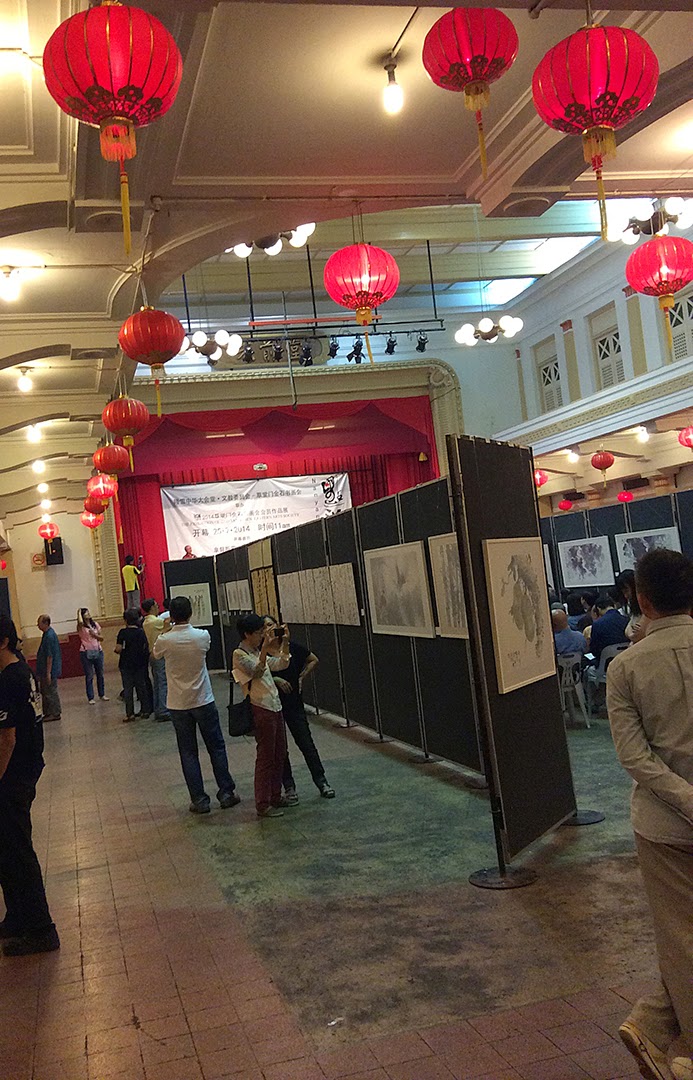
Malacca’s Li Chi Mao Art Museum is a repository of the works of Prof. Li Chi Mao, born in Woyang County, Anhuei Province, China, in 1925, and is considered a national treasure in Taiwan. The museum (art gallery) honouring him is situated on Lorong Hang Jebat, Malacca, and was hosting an exhibition of art relating to that city by five exceptional Chinese Malaysian artists - Yip Sek Quai, Chua Chay Hwa, Tan Puey Tee, Lau Mao Seng and Yeo Eng Hin. The exhibition was called Malacca’s Decade of Changes. It was a ‘joint painting’ exhibition.
And what, other than being Chinese Malaysians, you might wonder, was the significance of this exhibition in relation to the afore mentioned Nanyang style from Singapore. Well, as it turns out, three out of five artists exhibiting at Li Chi Mao were former direct students of the Nanyang Academy. Husband and wife team Chua Chay Hwa and Yeo Eng Hin graduated from Nanyang Academy of Fine Arts, in Singapore, 1978 and 1977 respectively, and went on to follow the links created with France, by Nanyang teacher Georgette Chen, by attending the Ecole Des Beaux Arts in Paris. Lau Mao Seng graduated from Nanyang somewhat earlier - in 1967. Tan Puey Tee is a retired school headmaster and self taught painter, while Yip Sek Quai graduated from the Kuala Lumpur Collage of Art, itself having connections to Nanyang Academy of Fine Arts, as the founder of Kuala Lumpur College of Art (Cheah Yew Saik) was, himself, a graduate from Nanyang.

As you might expect, from such a dynamic five person exhibition, there was a profusion of styles and images at Malacca’s Decade of Changes. A proliferation of fused Western and Eastern styles from Impressionism (Chua Chay Hwa) Expressionism (Lau Mao Seng - slated to feature in Dusun Quarterly soon) Cubism (Yip Sek Quai), as well as a blend of watercolour and Chinese ink painting from Tan Puey Tee. Yeo Eng Hin (featured in Dusun Quarterly 1 2013) rendered remarkable cityscapes in his own inimitable style, playing with texture and spectator/artist interaction. There is little doubt that the exhibition was a resounding success. How could it be otherwise with such experienced artists presenting their works for an eager public. Surrounded by intriguing artworks, we debated origins of Nanyang, its style and its forebears deferentially, and just a tad intensely as the audience was represented by many factions of the Malaysian art world - auction houses, galleries, artists and art critics (well, me). For me, the stars of the show were the ebullient, vibrantly energetic neo-Expressionist canvas-board oil pastels, vigorously created by Muar artist Lau Mao Seng.
Yet the surprises were only just beginning.
Opposite our, far from salubrious, hotel in Jalan Tun Tan Cheng Lock, Malacca, rested a small, yet fascinating, gallery of modern art - the Shih Wen Naphaporn Artist Studio. Owner, painter and all round good fellow Chiang Shih Wen (graduate of the already mentioned Kuala Lumpur College of Art) and his stunning artist wife Naphaporn Phanwiset, guided us around their artworks and what made the gallery tick, metaphorically that is.

Chiang Shih Wen’s artworks are heavily reminiscent of Dali’s Cubist Self Portrait (1923) and the Russian painter Lyubov Popova’s ‘Painterly Architectonics’ (1915 to 1919). Brightly coloured strips of Malacca’s Chinese, Dutch and Portuguese architectures tend to excite the visitor’s eyes, giving a remarkable visual flavour of Chiang Shih Wen’s Malacca. Taking trouble to execute detail, Chiang Shih Wen meticulously adds the text of Malacca sign boards to his imagery in multicoloured, scintillating, street scenes. As well as the obvious likenesses to various approaches to Cubism, there is something of the Fauve about that painter, forging his own painterly style in his fascinating home town.
In the studio, wooden trays of ‘Rembrandt’ oil colours and pots of workmanlike brushes shared space with Taoist/Buddhist figures, Yves Saint Laurent Belle D’Opium and L’Oreal Studio, as you might expect from an area shared by male and female artists.

Naphaporn Phanwiset (Chiang Shih Wen’s wife), had recently been painting images of luscious, exotic and maybe even erotic fruit, reminiscent of Lim Kim Hai (more of him down the page). Not long ago, Naphaporn Phanwiset had produced a peach painting. It bore all the well rounded and sensual hallmarks of a budding Georgia O’Keeffe. A table cloth with all the sexual suggestiveness of an 0’Keeffe, was mounted by very feminine peaches and masculine standing bottles. The painting seemed to revel in its potential lewdness. It was a triumph of feminism and female boldness. The question became rhetorical as the viewer might consider ‘how could she not paint fruit when her husband had, and their very good friend Lim Kim Hai (aka The Apple Man) does’, but Naphaporn Phanwiset, with O’Keeffe potential, has stripped away Lim Kim Hai's classicism, replacing it with a budding sensuality which one hopes will only grow and bare even more mouthwatering fruit, actual and metaphorical.
Master painter Lim Kim Hai was with us on that day, in Chiang Shih Wen’s gallery. Having taken our farewells of the gallery, we stepped back into the Malacca humidity and squeezed along the minuscule, ramshackle, pathways to Lim Kim Hai's studio gallery, also doubling as a repository for his collection of fine antiques, further along Jalan Tun Tan Cheng Lock.
Like Chua Chay Hwa and Yeo Eng Hin, Lim Kim Hai is a graduate of that famous Nanyang Academy of Fine Art. Also like them, he headed to Paris after graduation but stayed on until 2002, when he finally settled in Malacca to resume his painting. Lim Kim Hai is somewhat unfairly known as ‘The Apple Man’, due to the many canvases he has painted of that very European fruit. I say unfairly, because he has only been painting apple ‘portraits’ since the 1980s, and exclusively since 1990. Before his concentration on the one subject (apples), Lim Kim Hai had learned to paint, exquisitely, in a classical European (detailed) style.

Lim Kim Hai’s studio/gallery is at the rear of his huge collection of Malaysian antiques. Number 42 Jalan Tun Tan Cheng Lock (named after the founder of Malacca’s Chinese Association) was formerly the Dutch Heeren Street and is at the very core of the Unesco World Heritage Site of Malacca. Coming off the street, the first ‘room’ presented a wealth (literally) of antique furniture and silk carpets. The carpets reminded me of those I had witnessed in carpet showrooms in Northern India. Beautiful silk carpets with a unique silk sheen and delicate coloration. Gaps amidst the wall clad fruit cornucopia, indicated the spaces where paintings had been recently sent to Singapore, for a group exhibition. Wooden, antique, furniture brought the Chinese feel closer. Chairs for house and clan leaders differed from those of the lesser members of the family, but we were not there to ogle Lim Kim Hai’s antiques, as beautiful as they were, but to see his studio.

At the very rear of the antique gallery, Lim Kim Hai’s spacious studio piqued our curiosity. We were lucky to witness three canvases, in three different stages of completion, one standing on a terracotta tiled floor and the other two on wooden easels, one larger, one smaller. The artist explained his process, from initial background colour (in this case colours, brushed together to represent a golden hue), to the first tentative drawings of apples, through to his first colours and a near-finished work, replete with apple ‘portraits’. To my wife (she being a painter) he explained his painterly techniques and the lack of linseed oil, the use of varnish and turpentine (not white spirit). To me he explained that he kept his ‘subjects’ in the fridge. A moment of unease came over me until I realised that he didn’t mean dead bodies, but apples. With that he produced a bag of ’pommes’ (French), being kept fresh in his fridge, and laid them out for us to see the subjects of his current paintings.
The following morning, after July rain and tears in our eyes, we reluctantly left Malacca and dropped in on Muar, in the neighbouring state of Johor. Muar is an ancient city, believed to be older even than Malacca and, like Malacca, had been variously visited by the British, Dutch and Portuguese over the years. We were there to follow up on the brief meeting we had with veteran Nanyang artist Lau Moa Seng, in that Malacca exhibition.
The Malacca rain had followed us into Johor state, and its northern capital Muar. Through the rain we weaved with that infamous Butch Cassidy and the Sun Dance Kid song making the dampness a little more romantic than it really was. We found Eng Bee Book Co, amidst gardens that would put most Malaysian plant nurseries to shame, and were warmly welcomed by Lau Moa Seng and his enthusiastic family.
Picking our way through what was, in reality, not a book store but a wonderland art store, ducking under suspended flying frogs (more resembling Garuda than any frogs I had yet to encounter) and further marvelling at curious examples of colourful rocks on wooden plinths, we eventually came to the store at the rear of the building. And what a store it was, more like Warehouse 13 than a shop store, and in that virtual Chinese Aladdin’s Cave were life-sized wooden artist’s mannikins. imported from China. Unnerving male, female and child mannikins stood on huge shelving units, sternly, woodenly regarding us with eerily blank expressions.
In the main section was a corridor. To the left of that corridor, about four foot from the ground, was a long segmented rack, from which Lau Moa Seng began to pull canvas boards of his stunning paintings. It was estimated that there were well over two hundred oil pastel ‘painted’ canvases on those racks, all with a sombre black background from which sparkling colours would catch the viewer’s eye.

Muar life was represented, vividly, on those energetic canvas boards. They were the byproduct of many years of vigorous, vivacious Expressionistic fervour, as Lau Moa Seng sought to capture his neighbours and his neighbourhood in his hometown of Muar. Each canvas board was a lightning ‘sketch’, capturing the moment and, in many ways reminiscent of Georgette Chen’s works. Georgette Li Ying Chen was Lau Moa Seng’s teacher at the Nanyang Academy, in Singapore, she taught there from 1954 to 1980 and was using pastels exclusively during the 1960s. Lau Moa Seng graduated from the Nanyang Academy in 1967.
Lau Moa Seng explained that canvas board, alone, was suitable for his zealous way of working. Framed canvas was too flexible, unable to resist his animated way of working. He needed a surface resistant to his robust strokes of oil pastel, and small enough to be completed at one sitting en plein air.
Loaded with art books, art materials and a mind full of superb oil canvas board ‘paintings’, we bade farewell to those amazing people at the Eng Bee Book Co, and travelled south, to Johor Bahru. It was there that we reconnected with our dear interior design friend from the MIA (Malaysian Institute of Arts - founded by Chung Chen Sun, a Nanyang Academy graduate, in 1967), left our car and travelled on by bus, across the causeway, on to Merlion Island (Singapore), for research about the Nanyang Academy.
Foo Kwee Horng, a former assistant to Professor T. K. Sabapathy (along with Redza Piyadasa, a writer on all things Nanyang, and an inspiration to all art historians in Malaysia and Singapore) met with us and, through a couple of meetings, gave me information re the Nanyang Academy. It was a positive time in Singapore, the SAM (Singapore Art Museum), the Singapore National Library and the meetings that we had.
It was exciting to be in ‘Nanyang City’, the birthplace of a style, ideas, concepts of Western and Eastern art that began a fusion with the founding of the Nanyang Academy in 1938, and that historical trip to Bali in 1952. Nanyang resonates in Singapore and Malaysia to the present day. Our trip was a ‘look see’, in preparation for a much longer exposition. I pondered on that while Pei Yeou, my artist wife and graduate from MIA, drove us via Port Dickson, back to Selangor.