Tuesday, 20 April 2010
Meditative Minimalism?
From 29th May to June 19th, 2010, the visual artist Sand T (Sand T Kalloch) exhibits her most recent epoxy resin/clayboard works, in an exhibition entitled ‘Material Tendencies’, at Paris CONCRET, Paris, France, alongside artists from France and the Netherlands.
Last year I was very disappointed not to be able to see Sand T’s works, in her proposed solo exhibition, at Universiti Sains Malaysia (USM) in Penang. The exhibition was cancelled due to lack of financial support. It would seem a pity that an artist of Sand T’s international repute, and a home grown artist at that, was unable to draw sufficient support for her show. Thus denying many the chance to engage with her exciting works, and discover more about the art of minimalism.
Sand T was born in historical Melaka, land of Nonya/Baba, cincalok and gula. This extremely prolific artist, whose work is also in the Malaysian National Art Gallery collection, drifted towards the US of A for her Master of Fine Arts degree - and stayed on, in Massachusetts. There she has developed her stunning visual style and makes a point in promoting better understanding of fine art through her minimalist works and her ST Gallery.
For those more familiar with the figurative art of Zakaria Ali, Rafiee Ghani, or indeed the more abstract works of Latiff Mohidin and Ibrahim Hussein, Sand T’s take on minimalist art refreshes the senses that other arts cannot reach.
Michael Fried, in Artforum 1967, suggested that the concept of minimalist art, or liberalist art as he prefers, is an entirely ideological enterprise. To a large extent minimalist art separates itself off from modernist art, and more especially from the contemporary arts of the time – Op Art and Pop Art. Released from the boundaries of painting, minimalist art becomes freed from the need for pictorial illusion and, to a large extent, representation and ‘flat’ art altogether, in favour of an art utilising three dimensions.
Minimalism, in its stillness, transcends the mere mimetic, stripping away the irrelevant, revealing the fundamental and it is these very qualities which are inherent in Sand T’s works, and may go some way into describing the otherwise indescribable qualities of her transcendental, seemingly tranquil, art.
Sand T specialises in art made using epoxy resin, usually on a clayboard, with additional colour, and occasionally the use of graphite too. Her works are highly reflective, making use of internal colour and space as well as reflections and shadows cast onto her works.
There is a sublimely sumptuous quality about Sand T’s epoxy resin works which, though termed by the artist ‘minimalist’, actually defy categorisation. At moments when visitors wax lyrical, these highly polished and reflective epoxy resin works, often graced with graphite, appear to have freeze-framed 1970s lava lamps (as seen at the Massachusetts exhibition Negotiating the Irrationalities hosted by artSPACE@16). At other times the viewer might be encouraged to imagine that the tiny globules of semi-opaque fluid, are, seemingly, suspended, transfixed in time and space (Black Ecstasy B-2).
The self-delusionary viewer, who may or may not be a budding art historian high on the uniqueness of Sand T’s art, may imagine water droplets on the Pop Artist Allen Jones’ black patent leather boots (Voice of Silence), or perhaps the steamed windows of Dali’s surreal Rainy Taxi (Dancing Lights (clear)) as seemingly represented by Sand T’s radiant epoxy works; for there is little doubt that her works lend themselves to such reveries.
Old hippies may recall the 1960s band – Traffic, singing ‘...capturing moments of life in a jar’ from the song ‘Heaven Is In Your Mind’ (album Mr Fantasy-1967). From one perspective that is exactly what Sand T appears to do with her works. Observing globules of epoxy resin seemingly suspended within the works lends a notion of time transfixed, or caught. This notion might be encouraged by the resonance of the spectacular Time and Space B-1 (in the National Art Gallery, Kuala Lumpur), where carefully placed semi-translucent epoxy drips and lines, against a backdrop of deep reflective black, may give the viewer the illusion of a transcendental, Zen-space.
A mind oft used to indulgent fantasies might imagine strains of Miles Davis’ cool jazz, John Cage’s Dream (1948) or Phillip Glass’s Opening (from Glassworks 1981) frozen at a potentially mind-blowing ecstatic moment, solidified music, entrapped in epoxy resin, forever blowing, notes gelling into reality, reincarnated into resin.
In German philosophy, Martin Heidegger reveals the concept of the Augenblick, a specific minimal moment in time – quite literally the blink, or glance of an eye, time frozen, reduced to its smallest component part. And in many ways Augenblick may be enough to describe Sand T’s work, where drops of epoxy resin, on clay covered board, come to represent, in the eye of the beholder, infinite time and space encapsulated.
Whatever the viewer projects onto, or into, Sand T’s works, there is certainly little doubt that those works, whatever they may appear to be, are a trigger to meditation, or prayer, if ever there was one. For the viewer, observing Sand T’s work becomes inundated, washed with spiritual, Zen-like vibes; this is one of the most vital, intrinsic values of these alluring works - their innate ability to seemingly encourage contemplation and introspection.
Sand T’s frozen Zen drops are painstakingly placed for maximum effect, despite minimalist content, delivering surfaces which at once reflect an external world of physicality, while revealing a transcendental space for meditation, inner reflection and projection. Her intricately constructed resin works literally mirror external shifting reality while, simultaneously, capturing moments forever in stasis, sitting somewhere between realism and abstract, reality and construct.
While Sand T’s works have the appearance of trapping the moment, catching the Augenblick that notion is, in reality, a sheer fallacy, for movement and time continues reflected on the surface of her works in a gleam of her highly polished epoxy resin. The works’ surfaces, with their mirror-esque qualities, bring exciting new dynamics into an already complex artistic equation.
It is true that Sand T’s artworks may appear as stasis, time encapsulated, but that is all it is - a Platonic appearance, not reality. Where romantic artistic interpreters dream of flies in amber and imagine raindrops on tropical leaves (Euclidean Space in Electric Lime), sheen on black metal (Voice of Silence), condensation in taxis (Minus Space) reality is, in fact, reflected on the works’ surfaces.
Like froth on a daydream, life is being lived external to the epoxy resin works themselves - reflections of cameras, lights, visitors, and in the darkened gallery – shadows, all dance to the tune of light reflected on the surface of Sand T’s works. For that, essentially, fundamentally is the delicious tension of Sand T’s constructs – the projected into and the reflected onto. Ultimately her artistic constructs are non-representational, in so much as they are things/goods/objects in themselves, and need exist only for themselves.
I, for one, hope that Sand T may be persuaded to bring her works over to Malaysia, to exhibit them in a space worthy of them, so that a larger Malaysian public may share in what the world has already seen – the exquisiteness of form, the meditative grace of her epoxy resin coated clayboards, in all their unique splendour.
Thursday, 8 April 2010
Tuesday, 30 March 2010
Seni untuk AIDS 2 (Art for AIDS two)

The severity of the AIDS pandemic remains a prime concern across the world. Although statistics from major monitoring organisations, including UNICEF, UNAIDS and the World Health Organisation report some significant major changes in the virulence of the pandemic in Malaysia, there still remains a great need for awareness of HIV (Human Immunodeficiency Virus) and AIDS (Acquired Immune Deficiency Syndrome), particularly among the young.
In Malaysia, where there are more than 80, 000 reported cases of HIV infection, and nearly 14,000 reported cases of AIDS, official international and national organisations - like the Malaysian Aids Council (MAC) spearhead the fight against AIDS. MAC is seen to be in the vanguard of authorities spreading awareness and education concerning the pandemic, within Malaysia, but there also local, non-profit organisations, engaging in the devastating war against HIV/AIDS.
In between film making and music making, last year local artist/musician/academic Kamal Sabran teamed up with a project worker - Dr Ismail bin Lasa, president of Prostar Malaysia (programme for healthy adolescents) - a club raising awareness of HIV/AIDS among youth, to engage in the spreading of awareness about HIV/AIDS.
Together, doctor and artist initiated Art for Aids (Seni untuk AIDS), and successfully engaged in bringing the anti -HIV/AIDS message home to younger people.
The concept of Art for AIDS may have began in San Francisco (USA) some fourteen years ago, when a few local artists got together and decided to sell art to help their friends suffering from HIV and AIDS, but it continues worldwide with Malaysia also making its mark.
In 2009, Seni untuk AIDS (Art for AIDS) started in Malaysia as a network of artists, scholars and social activists pooling together ideas and resources to bring AIDS awareness to the general public’s view. Their intent was to raise consciousness, as well as funds, to continue the fight against one of the world’s most crippling virulent diseases – the HIV/AIDS virus.
Known as Fighting AIDS with Art – an online visual art competition and exhibition, the Malaysian Art for AIDS initiative (Seni untuk AIDS) founded a web based art competition which evolved into an exhibition with over two hundred stunning entries.
A website poll enabled visitors to vote for their favourite image, or the most effect/striking image and closed with 1,693 votes being registered on the website meter. Prizes were awarded for the top three artworks at a ceremony including the national poet A. Samad Said in Shah Alam, 20th February this year (2010).
Nur Suria Mansor won RM1000 for her evocative expressionistic work ‘Fading Away’ - a powerful piece full of emotive command, and obviously popular with the website voters. M. Syazwan gained RM500 for the nostalgically resonant image ‘Mangsa’ and Ammin received third, but not least, prize of RM250 for demonstrating, pictorially, ‘How HIV cannot be Spread’. All the artists and collaborators involved, as well as those who voted, deserve praise for just being involved in this initial project.

However, all art is in a way subjective, and the one work that caught my eye is – Jerit (scream), by Abdullah Hamdan (number 116 on the website). This is a poignant digital artwork, for me saying all there needs to be said about the fight against AIDS, the pain and suffering this disease brings not only to the individual whose body has been invaded by the virus, but for those connected to that individual, friends and family. The top 30 artworks can still be seen online, at http://seniuntukaids.blogspot.com .
That was merely a beginning. On the 28th March this year (2010), Perak witnessed the launching of a second initiative concerning art against AIDS. At the Prostar convention, in Bukit Merah, Perak, YB Datuk Rosnah Shirlin bt Hj Abdul Rashid Shirlin helped launch ‘Drop the Hate’, the fresh Seni untuk AIDS project initiative for this new year, concentrating specifically on photography.
Seni untuk AIDS, in this fresh venture, asks everyone, beginner, amateur and professional to send in their best photographic shots for the photography exhibition which closes 12 noon 31st May 2010. As last year, there will be cash prizes and certificates available to the winners, and there will be an online exhibition of the received photographs. Entrants are asked to send their photographic images to seniuntukaids@gmail.com by 31st of May this year.
As well as a second website – http://seniuntukaids2.blogspot, Seni untuk AIDS can be reached through a Facebook page. Links to Facebook and to the web pages of Kamal Sabran and Dr Ismail Lasa can be found on the aforementioned website if further information is sought regarding both the Seni untuk AIDS project itself, or this year’s initiative.
These initiatives are most important to draw attention to the AIDS pandemic, to facilitate spreading awareness of the disease, promoting ways in which sufferers may be assisted, and helping prevent fresh people from becoming infected in the future.
Wednesday, 17 March 2010
Tuesday, 9 February 2010
Saturday, 23 January 2010
Zulkifli Yusoff – A (n) Historical Survey 1996 – 2009
For an out of towner, or maybe even an in-towner, you have to be pretty determined to seek out Jalan Changkat Duta Kiara, in K.L.’s Mont Kiara. Bearing in mind that Mont Kiara is not mentioned on road signs until you are virtually on top of it, and the fact that you have to be agonisingly shrewd to understand that Sri Hartamas is a prelude to Mont Kiara. Once again, it is a case of having to know where it is, to know where it is.Geographical Location taken into account, it is a shame that the gallery is difficult to locate, because Zulkifli Yusoff’s partial retrospection exhibition, in Art Salon @ Seni, is a fascinating exhibition to visit.
Once you have by-passed the, seemingly permanent, builders’ yard of Jalan Changkat Duta, and entered the building, housing the underground exhibition, you are greeted with lounging dust-covered labourers and a telephonist/ receptionist wearing a paper mask. Not exactly the ambiance of a modern art gallery, but you have to be very, very patient, because the good stuff is below, down a flight of stairs, amidst boards propped against walls containing oddments of plastic pipe and baffling objects unconnected to the exhibition.
However, to be fair, I did arrive on the morning of the launch, one full day before the exhibition was due to open, at least according to the catalogue. According to other (internet) sources, the exhibition opened on the 6th of January, such is the (lack of) communication regarding these events.
To get to the ‘art,’ and by this time it is beginning to seem like the twelve labours of Hercules, you have to first slide past the young lady who, apparently, knows little about the exhibition – including the name of the artist, prominently displayed a few feet from her. For when she asks, “How did you know about the exhibition” and you reply, “The artist, Zulkifli Yusoff, told me of it,” she says - “Who.”
If you are really, really, patient then finally, and at last, you set sight on the exhibition itself, and with a huge sigh of relief, all those concerns just melt away, as, once again, Kuala Lumpur delivers yet another stunning display of some of the finest art in the world.
You may have caught Zulkifli Yusoff’s installation - ‘Merdeka 57’ during the ‘Go Block’ exhibition, at the Petronas Gallery, third floor, Suria KLCC (last year), or his installation - ‘sedangkan lidah lagi tergigit,’ (sometimes you have bitten your own tongue) fronting the upper galleries, at the Kuala Lumpur National Art Gallery (NAG). If you did, then you might have some sort of idea of the artist’s imagery in this latest exhibition.
If you did not see any of the artist’s previous exhibitions, then let me explain that, much of Zulkifli Yusoff’s latter works engage the exhibition visitor with acrylic printed image juxtapositions. They are sign and symbol concurrences in the manner of Pop Artists Peter Saul, Peter Phillips or even the inimitable Gilbert and George.Zulkifli Yusoff flexes this flat style to draw disparate images together to form a distinct narrative, which frequently relates to the emergence of Malaysia, from Malaya, and consequentially reveals conceptualisations of identity and place.
From screen printed images of war (planes and Samurai swords), film images of illustrious film idols - P.Ramlee and Saloma, up to and including a Time magazine cover proclaiming a new nation (Malaysia - April 1963), Zulkifli Yusoff reveals what it has meant, semiotically and symbolically, to be Malaysian, unshackled from the colonial yoke.
Weaving a comprehensive tapestry of imagery, from the 1940s, 50s and 60s, Zulkifli Yusoff achieves a narrative concerning an outsider’s view looking in (Ken Anakin’s - The Planter’s Wife, starring Claudette Colbert and Jack Hawkins, 1952) and an insider’s view looking out (R. Azmi and the afore-mentioned P. Ramlee). This, with the greatest of fortune for the onlooker, is not done is any dry, dull, academic exposition, but rather in a colourful, joyous, intriguing revelation which, while in one sense looks back to the works of Rezda Piyadasa, simultaneously looks forward to a fresh, exciting era of contemporary Malaysian art.As this is a partial retrospective of Zulkifli Yusoff’s work, there are many themes displayed other than the Malaya Series (2007 – 2009). This display, essentially, covers glimpses of the artist’s work from 1996 to 2009, but, sadly, excludes his magnificent installations, for this is a selling exhibition, in a private gallery, outside the remit of full retrospectives.
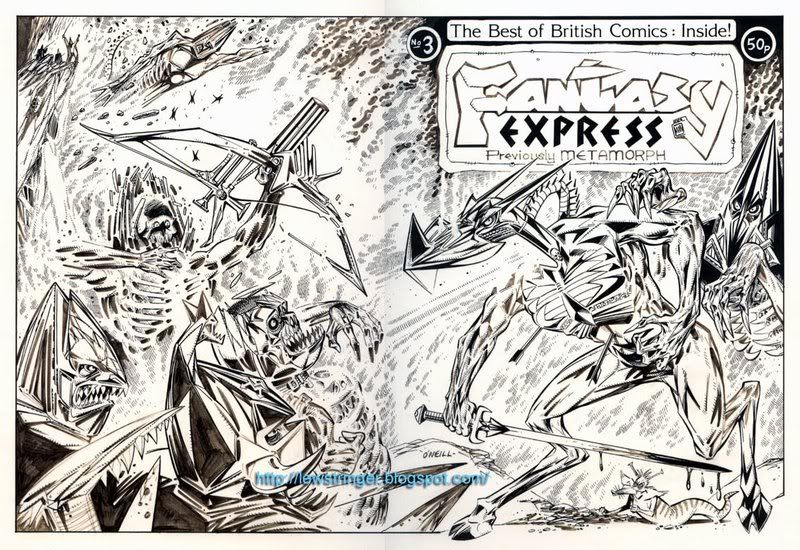
The few initial series, which grace the comfortably lit walls of the Art Salon @ Seni gallery - Brave New Art 1996, Brave New Art 1997, Ahmad and Jibul 1997, Reformasi Series 1999 and Current Event Series 1999, all hint at the Expressionism of a Malaysian James Ensor, or an Asian Emile Nolde.The artists ‘expressionism’, however, moves ever toward abstract, with a further two, intriguing, works, strangely reminiscent of the Latin American artist Wilfredo lam and the character Nemesis the Warlock (from the comic 2000AD) drawn by Kevin O’Neill.

These abstract images form part of the Early Malay Sketches series (2007 – 2009) - Jeligan (out of the corner of the eye) IV and Jeligan V, are oil painted, abstracted works full of painterly movement and dynamism. These artfully constructed canvases reflect the artist’s interpretation of short stories written about Malaya, by the first Resident General of the Federated Malay States - Sir Frank Swettenham (Malay Sketches - 1895). However, these canvases are not without their own air of cynicism - a gently cocked snook at Swettenham and colonialism, perhaps.
Whether it is Zulkifli Yusoff’s abstract expressionism or his latterly, Pop Art influenced, works there is a delicious thread of humour, or downright cheekiness, which seems to unite what, otherwise, might appear as a disparate collection of the artist’s work.
Early work in the exhibition draws upon cartoon and caricature, especially Ahmad and Brave New Art series, while the Malaya Series references popular culture, song and imagery contemporaneous to the decades 40s, 50s and 60s, to make its point.

In Malaya Series Study II (2009), twin images of actress Saloma, and actor/singer/ director P. Ramlee, radiantly smile from the canvas, amidst images of red roses and multiple images of romantic hearts. The smiling eyes and inviting mouths of these bygone idols appeal as infectious, provocative, reminiscences of romantic nostalgia, causing the infected viewer to smile in mirrored reflection, even if a little bemusedly.
On the other hand, humour extending from Malaya Series Study I and from Itik Pulau Pinang (Penang Duck) II and Itik Pulau Pingang II is a different form of humour, a cheeky, nudge, nudge, wink, wink humour, lustily delighting in equating a curvaceous woman’s swaying walk, with that of a waddling duck. This sentiment is revealed through the lines of R. Azmi’s song - Nona Singapura (woman from Singapore -1940s), occurring, at least in part, in each of these paintings, emphasising a forlornly bygone ribaldry.
Even in the more serious work - (no more coffee for you sir - 2009) the viewer continues to be provoked to grin at smiles on the faces of both Claudette Colbert and the Malay, songkok wearing, waiter, in this still from The Planter’s Wife. However, it is a very different type of smile, which attaches itself to the viewer’s mouth, more of a ‘knowing’ smile, brought about by the picture title’s dual meaning. Within this picture, amidst the familiar kopi tiam cups, saucers, Malaya stamps, teapots and cut fruit the title resonates - at once referring to a lack of coffee/ more coffee unavailable, or, alternatively, and specifically, no more coffee for the colonials/colonial time is running out for the planters and their wives.
There is much that I have not mentioned; including the Hot Temper Series (2005), and the First Malaya Series – The Planters (2008). It really behoves a visit to the gallery, to see the works face to face. All I can do, here, is give a glimpse of this mini retrospective and begin the process of exposition. I eagerly look forward to a major retrospective, perhaps at one of the larger galleries, nearer to the city centre where more people will be able to access the fine imagery and delicate symbolism of Zulkifli Yusoff’s work.Zulkifli Yusoff – An Historical Survey 1996 – 2009
Art Salon @ Seni
SENI Gallery
Lot 55350, Changkat Duta Kiara, off Jalan Duta Kiara, Mont Kiara, Kuala Lumpur.
16th January to 20th March 2010
www.theartgallerypg.com
Saturday, 16 January 2010
Subscribe to:
Posts (Atom)