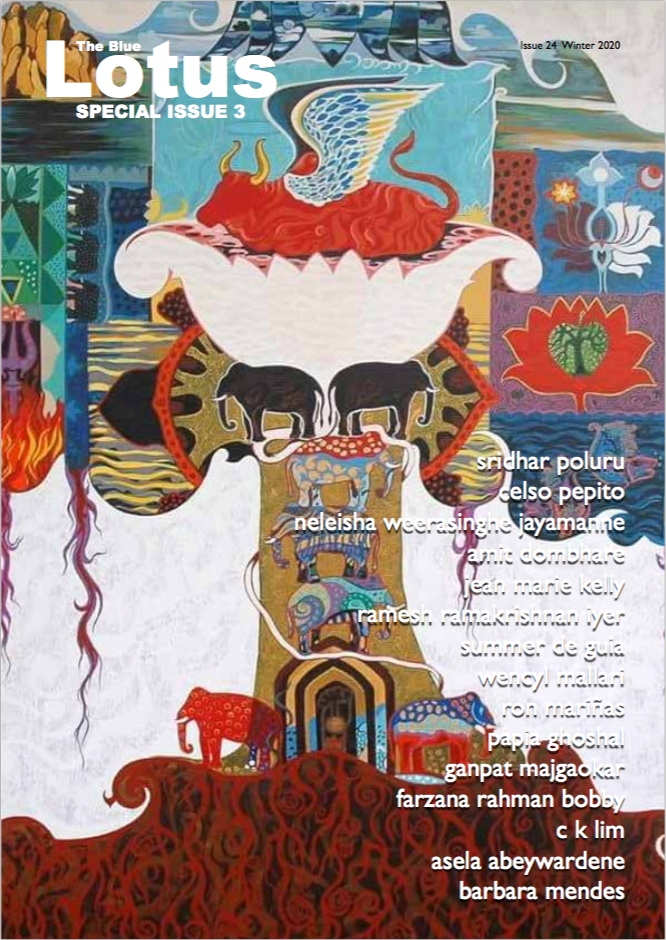
https://issuu.com/martinabradley/docs/the_blue_lotus_magazine_special_4
 |
| Papia Ghoshal - Game of Chess |
“Love’s Question”
And is this all true,
My ever-loving friend?
That the lightning-flash of the light in my eyes
Makes the clouds in your heart explode and blaze.
Is this true?
That my sweet lips are red as a blushing new bride,
My ever-loving friend,
Is this true?
Extract from ‘Love’s Question’, Rabindranath Tagore.
“Selected Poems” trans. Willian Radice Penguin Books, 2005
“Forbidden Dreams - The world beyond eroticism by Papia Ghoshal in Woburn Gallery, London” is the title of a video taken in the now closed Woburn Gallery formerly of 14 Woburn Walk, in salubrious Georgian Bloomsbury, London. Incidentally, Woburn Walk was once a residency of Irish poet W.B. Yeats.
The aforementioned video is our YouTube encounter with the exhibition ‘Papia Ghoshal, an exhibition of paintings’ held between the 2nd and 15th of July, in 2006. This was one year after the artist’s highly successful exhibition ‘Forbidden Dreams’, at the Chitrakoot Art Gallery, Gariahat Road Kolkata (2005), as mentioned in the Indian Telegraph newspaper. Earlier (2003) Gholshal had exhibited at the prestigious Academy of Fine Arts in Kolkata, revealing some sixty paintings on a similar theme, with notions of ‘taboo’ and ‘maleness’ remaining in the artist’s mind and oeuvre. More recently (2012), the Times of India had reported on Ghoshal’s exhibition 'Tantra, Shunya', which was held at the Azad Bhavan Art Gallery, Kolkata, and was supported by the Indian Council for Cultural Relations.
There are, obviously, many questions which arise from the West Bengal artist's potentially provocative works and, more specifically from the video and former showing’s title - Forbidden Dreams, and the works therein. Within the first few frames of the video ‘Forbidden Dreams….’ we (the viewing audience) are led as Alice into Dobson’s Wonderland, from a London tree-shadowed pavement, glimpsing the gallery’s name as we go, and digitally emerge into the rabbit hole of a ‘Grade 2, listed’ building (part of a terrace of 8 shops, originated in 1822 by Thomas Cubitt).
The antique ambience of the Bloomsbury gallery already legitimises Ghoshal’s hangings as, effectively, we become at one with a thronging crowd of art enthusiasts, luminaries and their collective ‘knowing’ hubbub. Before us, on an easel, is Ghoshal’s ‘Game of Chess’ - on the canvas is a chess board shaped like a black American footballer’s body. Poignant, as the theme of love, forbidden, revolves around ‘Games People Play’ (Eric Berne), and chess specifically which references both ‘Shatranj Ke Khilari’ (in English ‘The Chess Players’, directed by Bengali film maker Satyajit Ray who, like Ghoshal, was from Kolkata) and chess which is thought to have originated in India. Beyond that easel-held canvas is, quite literally, a window onto an outside world of greenery.
Entering, instantly we are introduced to the melodically plucked strings of Sebastian Dreyer’s sitar. It is there, after our fall into Wonderland, that our intertwining begins. We become effectively intertwined within those lilting sitar strings as well as the beckoning sights of Ghoshal’s mesmeric sensual imagery. Dreyer’s sitar emphasises the exoticness of India and prepares us for encounters with South Asian ‘otherness’. From the sight of ‘Game of Chess’ we are led to the artist herself, dressed beguilingly in a white sari with green floral sari blouse emphasising her links to the earth and to Shakti/Kali/Durga the quintessential embodiment of female power
Rabindranath Tagore in his poem ‘Love’s Question’ (above) provokes concerns of the Platonic duality of appearances and reality (Plato’s Cave analogy in The Republic). We project, Tagore intimates, onto the object before us, imbuing it (or she) with our reasoning and our whims. An appearance of reality (flesh and blood) is only half of what we encounter, the rest is our conjuring (fantasy of our mind). Ghoshal, in snippets of dialogue during the fifteen minute thirty-three second video, intimates that it is the very same with the appearances of equalities within society, more specifically the equalities of sex and gender where females (to all intents and purposes) have the illusion of power, but in reality continue to be subjected to a covert, and age-old, domination by males. As Ghoshal faces a painting of a balance (‘The Market’), female forms in one pan and a large snake-like penis on another, she mentions
“This balance beam shows how the man is still dictating terms over many women in today’s society.” she continues “...today’s women even in the first world countries apparently seem to dominate the man but in reality the man still dominates...you really cannot speak out”.
It is forbidden to do so, there is a taboo on real gender equality not only in Ghoshal's 'mother' India, but globally.
Sigmund Freud, who caught the 20th century imagination in the 1908 reworking of his 1905 'On the Sexual Theories of Children', with his observations of sex, and in particular theories such as, ‘Oedipus Complex’, ‘Castration Complex; and his now infamous construct ‘penis envy’, which he claimed all females endured. Incidentally Freud had a twenty year (1921 - 1937) correspondence with Girindrasekhar Bose, who became the champion of Freudian psychoanalysis in India and was called the ‘father of psychoanalysis in India’ and founder of the Indian Psychoanalytical Society (at 14, Parsi Bagan Lane, Kolkata).
“To Freud, women were simply men without penises (Cohler & Galatzer-Levy, 2008), so naturally he introduced a stage of ‘penis envy’ – where a woman realises she does not possess a penis, and experiences an envy of the male, which accounted for much of female behaviour. Freud claimed that the only way they could overcome this penis envy was to have a child of their own – even going as far as to suggest they wanted a male child, in their efforts to gain a penis.”
Riya Yadav, Freud and penis envy – a failure of courage, The Psychologist, June 2018, Vol.31 (pp.92-94)
In the West Freud’s ‘penis envy’ theory only legitimated already existing gender inequalities. Others have disputed Freud’s claims, such as Luce Irigaray, Julia Kristeva, and Hélène Cixous who reinterprets the concept of ‘penis envy’ from a female perspective (as does Ghoshal).
“Though masculine sexuality gravitates around the penis, engendering that centralized body (in political anatomy) under the dictatorship of its parts, woman does not bring about the same regionalization which serves the couple head/genitals and which is inscribed only within boundaries. Her libido is cosmic, just as her unconscious is worldwide.”
Hélène Cixous, Keith Cohen, Paula Cohen, The Laugh of the Medusa, Signs, Vol. 1, No. 4 (Summer, 1976), pp. 875-893
Cosmological connections with the male and female members occur within Indian cosmology, and specifically in the more usual Śiva and Śakti interwoven religious traditions (Tantra - woven/intertwined) and Kashmir valley Indian visual depictions. These revolve around the male member and are chiefly limited to Shiva’s erect ‘lingam’ (penis), and to the female genital, the ‘yoni’(vagina and vulva), a receptacle usually depicted beneath the male. These images also occur within the Vajrayana Buddhism tradition.
Lingam and yoni are worshiped by Shaivites (followers of the Indian god Shiva, also known as Adiyogi Shiva, regarded as the patron god of yoga, meditation and arts), in their homes and temples. Statues are anointed with many items including oil and flowers. The piercingly erect lingam, made of hard substances such as stone, wood and metal, is in opposition to the often flaccid examples portrayed in the exhibitions of work by Papia Ghoshal. Her soft, erectile dysfunctional and often uncircumcised, penises (such as in Forbidden dreams 1) may be observed as a feminist move to debunking notions of a natural male mastery. By portraying images of penile softness, akin to that soft Camembert cheese melting in the sun which inspired Salvador Dali to create his ‘The Persistence of Memory’ (1931) Ghoshal renders a source of male power dissipated.
One of Ghoshal’s works (Forbidden Dreams 6, 2003) appears to be a woman mounted on a large penis. It brings to mind a gouache painting by an unknown Indian painter of 'A woman riding on an enormous winged penis’ (circa 1900, found in the Wellcome Collection), like one other of Ghosal’s paintings (Peek Through Darkness) the main subject appears to have the feet of a cockerel (in English a play on words). Ghoshal’s ‘Forbidden Dreams 11’, with cockerel feet, and ‘Forbidden Butterfly’ are more reminiscent of ancient Roman winged phalluses (such as the ‘Roman Bone Winged Phallus’, 43 and 410BC, found in Suffolk, Britain).
Within Ghoshal’s oeuvre there is little doubt that the female (Ghoshal) is dominant. Phalluses clamour for entry in ‘Menstruating Eye’ (2007), come disguised as snakes in ‘Snake and Ladder Game’ (more games), and occur very subtly in ‘Radha and her Krishnas’ and symbolically in ‘Manasa’. Constantly the viewer observes Ghoshal’s images of Kali (Linga Purana, 500 to 1000 CE) and Durga (Shiva Purana, possibly 10th Century CE) with their superior female power derived from Shakti, with and without phalluses present.
It is interesting to note that Ghoshal exhibited at the Nehru Wangchuck Cultural Center, Bhutan, in 2011. Since the 15th century, Bhutan has become renowned for the Lama Drukpa Kunley who has been titled the ‘Divine Madman’ for his unorthodox introduction of sexuality into his teachings.
“I take refuge in the virile young tiger’s Thunderbolt,
rising proudly, indifferent to death;
I take refuge in the maiden’s Lotus, filling her with
rolling bliss waves, releasing her from shame and inhibition.”
~Lama Drukpa Kunley (The Divine Madman)~
Phalluses, and phallic imagery, are everywhere in Bhutan, on walls, doorways, carved small and large, brightly coloured made out of stone, bamboo, ivory. Some of which are directly attributed to Lama Drukpa Kunley. It is thought that once an individual has accepted that they are bound by taboo and ritual, freedom comes by observing those ties, that then allows observation, acceptance, and the release of guilt. This enables refocusing and the creation of positive beliefs and thoughts.
In the 'Forbidden Dreams - The world beyond eroticism' video it is suggested that the exhibition is a “sequence of meditations on the male body, exploring its sexual grace, its power and its sadness.” Sadness, perhaps, because even the Shiva lingam (penis) is powerless without the Durga yoni (vulva and vagina) into which to spill its seed. Ideas from Lama Drukpa Kunley, drawing from Tantra, have been seen by the West as speaking of things ‘Forbidden’ and/or ‘Taboo’.
On the subject of ‘Forbidden’, while visualisation of sex, particularly in Victorian England, had drawn to it notions of prudery. One book (a sixpenny book on the sex in 1877, purported to be ‘The Rudest Book In Britain’) championed birth control, and was taken to court for the obscenity trial of Annie Besant and Charles Bradlaugh. Yet Jan Marsh (at the Victoria and Albert Museum) defends a very different position. She indicates that records show that the 1860s were as sexually active as the 1960s (Sex & Sexuality in the 19th Century), thus indicating that notions of Victorian ‘Forbidden and Taboo’ are just as fugitive as there are today.
It is not unheard of that female artists take an interest in male anatomy, as between 1968–99, and finally cast in 2001, Louise Bourgeois’ ‘Fillette (Sweeter Version)’ is a latex over plastic sculpture of dishevelled penis and scrotum. While in 1974 Lynda Benglis created ‘Smile’, a cast bronze depicting a penis with two ‘tips’. One exhibition, held in 2016, titled, ‘The Female Gaze Part II: Women Look at Men’, and curated by Cheim & Read, June 23 – August 31, New York, gathered together a selection of female artists including Berenice Abbott, Ellen Altfest, Ghada Amer, Diane Arbus, Gina Beavers, Lynda Benglis, Huma Bhabha, Louise Bourgeois, Katherine Bradford, Cecily Brown, Kathe Burkhart, Lois Dodd, Marlene Dumas, Tracey Emin, Katy Grannan, Grace Graupe-Pillard, EJ Hauser, Celia Hempton, Jenny Holzer, Chantal Joffe, Sarah Lucas, Catherine Murphy, Alice Neel, Catherine Opie, Collier Schorr, Dana Schutz, Joan Semmel, Cindy Sherman, Sylvia Sleigh, Betty Tompkins, Nicole Wittenberg and Lynette Yiadom-Boakye, ‘talking’ about maleness and the male body.
It practically goes without saying that the exuberance and innovation of Ghoshal’s canvases, concerning the male body, would not have looked out of place in that New York exhibition.
The video 'Forbidden Dreams - The world beyond eroticism by Papia Ghoshal in Woburn Gallery, London' closes. The Woburn Gallery has closed. Papia Ghoshal and her works continue. Ghoshal is a creator. She brings to life canvases, sculptures, poetry and performances in which she presents the Durga/Kali ‘shakti’ (energy, power) of the female, not in opposition to the male, but as well as the male. Ghoshal reveals ‘maleness’ in all it’s fragile glory, its strengths and weaknesses. Being male is to be human, one half of humanity, not superior nor inferior but alongside, and intertwined.

Black is not exhibited in so elementary a state as white. We meet with it in the vegetable kingdom in semi-combustion: and charcoal, a substance especially worthy of attention on other accounts, exhibits a black colour. Again if woods - for example, boards, owing to the action of light, air, moisture, are deprived in part of their combustibility, there appears first the grey then the black colour. So again, we can convert even portions of animal substance to charcoal by semi-combustion.
Johann Wolfgang von Goethe, Theory of Colours, 1810.
In Bangladesh’s cooler month of February (2019), I had the great pleasure of meeting the former actress and playwright turned artist, Bipasha Hayat, at her home studio in Dhaka 1212. She is the daughter of actor and film director Abul Hayat, and is married to actor and film director Tauquir Ahmed.
Bipasha Hayat has made an international name for herself as a Bangladesh ‘Conceptual’ artist and has turned her attention to one of the most important areas of human existence – memory. Issues of our humanity, identity, self, ‘I’ and ‘Other’, culture etcetera are reliant upon being remembered. In a series of intriguing works Bipasha Hayat has woven a tangible treatise on memory through the colour black.
“Memory of past episodes provides a sense of personal identity-the sense that I am the same person as someone in the past. … the sense of identity derives from two components, one delivering the content of the memory and the other generating the sense of mineness…. In addition, articulating the components of the sense of identity promises to bear on the extent to which this sense of identity provides evidence of personal identity.”
Memory and the Sense of personal Identity Stanley B. Klein and Shaun Nichols, Mind, Vol. 121, No. 483 (July 2012)
In her series of images comprising the installation ‘Cast My Vote For Socrates' Acquittal’ (2020) Hayat references the Greek philosopher Socrates’ sentence of death in 399 BC (B.C.E.). According to the ancient Greek philosopher Plato (in The Apology), Socrates’ crimes were ‘failing to acknowledge gods worshiped by the city’ and ‘corrupting the young’. In her hand-pressed impressions, printed from chiselled stone and black acrylic paint on 221 pieces of watercolour paper, Hayat brings back to our cultural memory the injustice served on one of the greatest Western philosophers of all times. The number 221 references those who voted for Socrates’ acquittal (220), plus her own vote, against the 280 votes for his demise via the drinking of hemlock. The artwork is her vote against injustice, historical and current. Remembering that initial trial, some two thousand and four hundred years later (2012), a new international panel gathered to re-run Socrates’ trial, in Athens and, ironically, acquitted him of his crimes.
In other works, such as her ‘Memoir’ series (2016), Hayat uses corrugated cardboard painted black and rendered to intimate words, spaces, sentences, even paragraphs. With raised sections initially ‘reading’ as anonymised and coded segments of ‘text’, the viewer observes what once, from a distance, appears as text recodes itself before their eyes into the corrugated board painted black, which it is. The viewer misreads, mis-recalls and mis-projects images from memory, onto the presented artwork. As the visitor’s brain conjures, clinging to the initial notion of text, desperately trying to make meaning where there is none, their thoughts bid for logic, rationality, and auto-realign to thoughts of Braille (the system of raised dots read with fingers by people having low vision, or who are sight less). As the viewer closes on the artwork fresh recollections occur. Perhaps this enigmatic work, though not text in the common visual sense, can be ‘read’ through touch, though touch is not permitted within the viewing space.
The work confounds and puzzles. Memories dragged up are catapulted at the artworks, hoping that one might stick; that the recalled memory might decode the not encoded. It doesn’t of course. The text, which is not text, only hints at some, seemingly unassailable, language.
As intimated by Goethe, charcoal (that which is especially worthy of attention, see above) makes a mark of black colour. Black may be both absence and presence. Black, as text, offers to reveal but as asemic text rescinds that offer in favour of mystery and conundrum. Black can both obscure (as in Hayat’s Memoirs) and reveal. The beauty of faces, of human and animal bodies, of delicate plants, of thought and intention are revealed in the work of artists such as Albrecht Dürer, Édouard Manet, Edgar Degas, and Henri de Toulouse-Lautrec. Or, there again, with Chinese black ink made from a mixture of soot and animal glue, such as in the works by Qi Baishi and his ‘ink wash shrimps’ (1951) or the ‘Famine Sketches’ (1943-1944) of Bangladesh’s Zainul Abedin Mymensingh. While charcoal black, and black ink, may communicate through images and ‘writing’ from the conscious mind, with the intended expedition of acts of communication, there are other ‘texts’ which spring from the subconscious, and which communicate in a less than linear fashion, like the ‘Memoir’ series (above).
The making of marks has been intrinsic to humanity from the first cave dwellers, and their awaiting walls, to the black on white text of the hand phone screen. Since early 800 AD with the advent of Chinese printing and later with the world’s first moveable type in China (11th century) we have entrusted our memories to devices and objects exterior to ourselves. We draw, we report, we send and we display but we also save, hold data in our memories, on our computer hard drives and external hard drives. We back up, save to hard copy, preserve memories in books, essays, files, in boxes, on shelves and in rooms because our memory recall cannot be relied upon unless we have eidetic (photographic) memory, which few have. And that was the prompting behind the first Chinese printing, to promp the oral story tellers. Bipasha Hayat reveals our dependency upon access to memory in her works concerning the use of black and it's innate ability to both reveal and obscure.
While it is generally considered that white reveals and black conceals, when we consider the ‘tabula rasa’, the blank page (probably white) we are considering a background to script, or text or image. If we were to write or type white words onto the white page, we would see little. If, on the other hand, we write or type black words onto that same white page, our thoughts will become revealed.
French Poet and writer Andre Breton was intrigued by the writings of Sigmund Freud and his enquiries into the subconscious mind. Since 1913, Breton engaged in the process of automatic writing and later, with the Dadaists especially with Philippe Soupault, furthered his interest in the notions of automatic (subconscious) writing, or surrealist automatism (occurring in the book Les Champs magnétiques The Magnetic Fields, 1920). Breton mentions that…..
“Psychic automatism in its pure state, by which one proposes to express -- verbally, by means of the written word, or in any other manner -- the actual functioning of thought. Dictated by the thought, in the absence of any control exercised by reason, exempt from any aesthetic or moral concern.”
Later Breton originated the first Surrealist Manifesto (Le Manifeste du Surréalisme, 1924) which outlined his ideas about art and literature concerning the subconscious and the symbolism of dreams. While Breton and others wished to bypass the logical, conscious mind and access the subconscious and its non-filtered thoughts and ideas, they were unaware of one tribal people in India who had no access to literature, but nevertheless produced something the Surrealists would have been amazed by.
The Hill Korwa, living in the Lalarpat and Baladarpat villages in Raigarh District, Madhya Pradesh, India, have no linguistic, written, script. They do, however, produce what has been termed a ‘Magic Script’, that is to say a text-like calligraphy which is not born from language but is ‘painted’ as ‘magical messages’ (J. Swaminathan) by these illiterate tribes people.
This Korwa ‘Magic Script’ resembles the concept of asemic writing, generally seen as writing which is a wordless, open, semantic form of writing, and having no specific semantic content. Asemic writing (or script) creates tension. It ‘talks’ about the confusion between the thing seen and the thing it is pointing to, as per Belgium Surreal artist René Magritte and his ‘The Treachery of Images’ (1929) proclaiming that a painting of a pipe is not a pipe (Ceci n'est pas une pipe). This is the area of interest for the practitioners of asemics, in assisting the ‘reader’ to focus on the actual work, its marks and its swirls and to study them for what they are, not for the ‘words’ and their meaning being represented.
Asemic calligraphy arranged across draped black muslin in Hayat’s ‘Shadow of Memories’ are reminiscent of Dada and the Surrealist notion of ’Psychic Automatism’. Images rendered onto the draped muslin resemble text, just as the cardboard indentations did in Hayat’s ‘Memoir’ series. Once again the viewer is challenged by the appearance of text that is not text, but the appearance of text. Again the mind wishes to decipher and asks ‘is this the text of another language?’
In Byzantine and Renaissance paintings in the 14th and 15th centuries, there occurred design motifs in certain religious paintings which mimicked, but were not, ‘Eastern’ script. This faux script is known as ‘Pseudo-Kufic’ or Kufesque script. It frequently resembles arabesque styles of lettering, and is painted as embroidered decoration on the hems of garments or edges of carpets in wonderfully detailed paintings. The word ‘Kufic’ explains an early angular form of the Arabic alphabet, found chiefly in decorative inscriptions. The above mentioned scripts had the appearance of, but was not, Arabic. They were representations without textual meaning, and were used for decorative purposes and frequently presenting an "oriental" atmosphere to paintings with regard to individuals or, in particular, Holyland scenes.
Hayat’s ‘Shadow of Memories’ ‘script’ is hand rendered. To all intents and purposes is ‘in the wind’. The installation’s black muslin has the possibility of a fluidity of movement of, essentially, throwing its ‘text’ to the wind, making it tentative, possible, but uncertain just as the script itself appears laden with possibilities, but remains an enigma and undecipherable. Those works of Bipasha Hayat are the antithesis of the idea of Tibetan prayer flags, which traditionally are hung in high places to catch the wind so that the Buddhist prayer is carried to bless all sentient beings. Hayat’s works proffer but rescind.
In Hayat’s ‘Shadow of Memories’ there is also the sensation that we might be looking at the darkness of memory loss, through degenerative diseases like Alzheimer's, where working memory and long term memory are affected early and where sufferers encounter difficulties in the retelling and reading of texts. In a sense, we the observer of Hayat’s black asemic scripts are forced into the role of the recipient of a degenerative brain disorder. There is much (deliberately) ‘lost in translation’. Much we cannot quite grasp. We become thrown onto the images that are not words, like films in languages which we do not understand, sans subtitles to guide our otherwise active mind (s) through the complex plot twists. There again, we are faced with something resembling the fascinating non-textual, but illustrative, ‘magic scripts’ of the Korwa. Yet Hayat’s work does not use her asemic imagery as an exotic decoration like the pseudo-kulfic script, but more like an offering akin to the Korwa’s ‘magic scripts, and with her works we, her audience, are forced to accept that there may be meanings other than those we can effectively grasp as she intrigues and teases her audience with hints.


I sit here (in Cambodia), awash with sounds of the gamelan, as the Director of the 17th Asian, African & Mediterranean International Modern Arts Exhibition, Luo Qi (China’s foremost exponent of Calligraphysm and Characterism), sits in Portugal and many of the artists featured in this new online exhibition sit in their respective countries, or are displaced and awaiting passage home. My sky is blue. Sunlight streams gently through my apartment’s open door. There is a slight breeze rustling the bamboo. White butterflies dance of joy.
In other times, this truly cosmopolitan exhibition would have had a splendid physical presence.
For sixteen years, and from divers countries, artists have gathered in places including Luo Qi’s Chinese hometown of Hangzhou, China. While these exhibitions have always been international, the move to digital has allowed many more artists to participate. This time there are participants from Australia; Bangladesh; Brazil; Bulgaria; Canada; China; France; India; Indonesia; Iran; Italy; Japan; Korea; Madagascar; Malaysia; Mauritius; Mexico; Morocco; Nepal; Philippines; Portugal; Serbia; Seychelles; Singapore; Slovenia; Thailand; Togo; Sri Lanka, United States of America, and Vietnam. The artworks of those chosen artists are open to the world, and not just to be seen by cultured art aficionados, but rather any, and all, intrigued and fascinated faces.
In the past artists had to physically create their exhibitions. Stepladders erected, drills, Rawlplugs and all the other paraphernalia of exhibition making would have been at hand, and busy in hands erecting not just their own but each others creations. Camaraderie, sheer joie de vivre and all the wonders of team spirit had been naturally sparked during the coming together of the exhibitors, the exhibitions, and their audiences echoing the overall meme of international cooperation, engendered by Director Luo Qi.
This year (2020) is slightly different.
In many senses Luo Qi is a modern day Chinese Admiral Zheng He. Like the famous, (or is that infamous) adventures of Homer’s Odysseus or the seven voyages of Zheng He (ambassador and explorer), Lou Qi has navigated his way to countries near and far. In now seventeen ‘voyages’ Luo Qi has collected not giraffes and jewels, but merchandise far more precious – world artists and their art. Instead of physically sailing the seven seas, this year Lou Qi has ‘surfed’ the World Wide Web. Ever expanding his horizons, Lou Qi has set his sights on a global Internet collaboration of artists and brought together over one hundred artists, of whom seventy plus have been chosen to celebrate the 17th (annual) Asian, African & Mediterranean International Modern Arts collaboration, in an online exhibition.
Luo Qi asked me to commit to the momentous task of commenting on some of the works on show for the exhibition. Of course I was not able to write about all, so you have my apologies for that. I was full of mixed feelings and mixed loyalties, for I have known some of the participants and have enjoyed their artworks over many years. I struggled with impartiality and ultimately wrote down the names of those artists whose work connected with me most, as I scrolled through. I hasten to add that the situation I found myself in was to choose a ‘first among equals’, an impossible task; however I will mention those artists I did choose and the works that I was particularly struck by; in country alphabetical order.
China
Shi Jianguo creates using coloured inks on paper. He depicts (largely) emancipated female qipao (cheongsam) wearing graphic ‘characters’. They have the distinct appearance of stepping out from circa 1930’s Shanghai, with all the cultural visual ambiguity that might entail. The rouged lips of these socialite or upper class women are often pursed, sometimes wantonly smiling and frequently obscured by elongated fingers holding cigarettes. Shi Jianguo’s works are splendid caricatures that, in another age, might have been seen in Chinese magazines such as Modern Sketch or considered as a pastiche of images in the magazine (Liángyǒu) The Young Companion which reflected Shanghai’s growing colonialist cultural identity.
Zhang Fangbai, one of China’s modernist calligraphers, usually specialises in the depiction of birds of prey however, in these three innovative paintings he presents a literal ‘bird’s eye’ view of the ancient traditional of Chinese landscape. In these images Zhang Fangbai re-perceives notions of the art of Chinese ink brush painting by using the synthesis of a more modern Western approach of painting with oil on canvas and ideas inherited from ink brush tradition. The three canvases presented are a reverential salute to the past while simultaneously being an acknowledgement of China’s modernity and unification with Western and Eastern ideas.
India
Maitreyi Nandi’s exquisite artworks, which to some in the West may appear to illustrative, follow a distinct modernist path set down by India’s premiere modern artists such as Jamini Roy and Gaganendranath Tagore, who referenced local Indian visual folk traditions to present their own brands of Indian ‘Modernism’. Maitreyi Nandi paints (often) seductive, positive, images of the plight of women. Some enlightened women are depicted within the Hindi mythos as goddesses, or mothers in frequently glowing representations of Indian fables. Maitreyi Nandi follows in the footsteps of pioneering female Indian artist such as Amrita Sher-Gil, Pratima Devi and many others.
Italy
Marcello Schiavo’s delicate yet intriguing watercolour landscapes are somewhat reminiscent of the Impressionists’ works in the way they are able to both capture light and our imagination. His ethereal touch graces his substrate and our vision. There is a hint of a prayer to nature, or a meditation on nature in his light and airy works. His images enable his subjects to breathe, while his viewing audience must catch their collective breaths at his stunning portrayals. Marcello Schiavo’s works might be compared to those of England’s Joseph Mallord William Turner for, like Turner, Schiavo was a skilled draughtsman and an adept watercolourist.
Korea
Shin Young Ho is a surrealist inspired artist. He is also a most unusual modern Korean calligrapher, who specialises in rendering huge brush strokes, on paper. His chief meme is nature, specifically the minutiae of insects like ants and mosquitoes, painted large, as if seen under a microscope, some with black ink, or black ink and a colour wash. His well-defined ants seem very Dalian. Salvador Dali created images of ants in his paintings to represent desire and the decay he encountered as a boy in Catalonia. Shin Young Ho’s ants, though mostly black, sometimes occur as red against a grey wash, but are always stunning in their size and clarity.
Madagascar
Pierrot Men, is a photographing artist specialising in classical black and white photographic images. In his sensitive, yet outstanding, images of simple, humble people Madagascar people he rivals photographers such as Robert Frank and Daidō Moriyama, giants of photography. Images of the lives of ordinary Madagascans come alive through his lens in rich black and white, revealing not just the working lives of the people but the photographer’s intense love for them. Elsewhere his work has been likened to photographic poetry, delicate yet intense, for he has the keenest of eyes coupled with the quickness of thought to capture otherwise ephemeral moments.
Sri Lanka
Asela Abeywardene, is a ceramicist extraordinaire. Gaining inspiration from nature and the stillness of her religion, the artist has developed an organic approach to pottery that reflects the beauty as well as the tenuous nature of existence. As you might expect, coming from an island imbued with a long history of Buddhist, there is a Buddhist nature to her works as well as intimations of the sea. Delicate forms dripped or stroked with green, and as tentative as the leaves they echo, remind us of our fragile existence. There are hints of the best of Art Nouveau and Art Deco in her works, melding artistic creations East to West to produce her uniqueness.
Vietnam
Tao Huong delights in painting nature as well as engagingly colourful portraits (seen elsewhere). Seen here are three engaging landscapes full of energy and movement, yet each capturing a different moment and a different hue, reminiscent of the work done by Claude Monet with haystacks and the different aspects of light on Rouen Cathedral. Tao Huong’s works give depth for the viewer to sink into. In each of the paintings the hues are carefully balanced for harmony, yet of the three it is the brown landscape that has me transfixed by its intriguing perspective, and balance of warm and cooler colours.