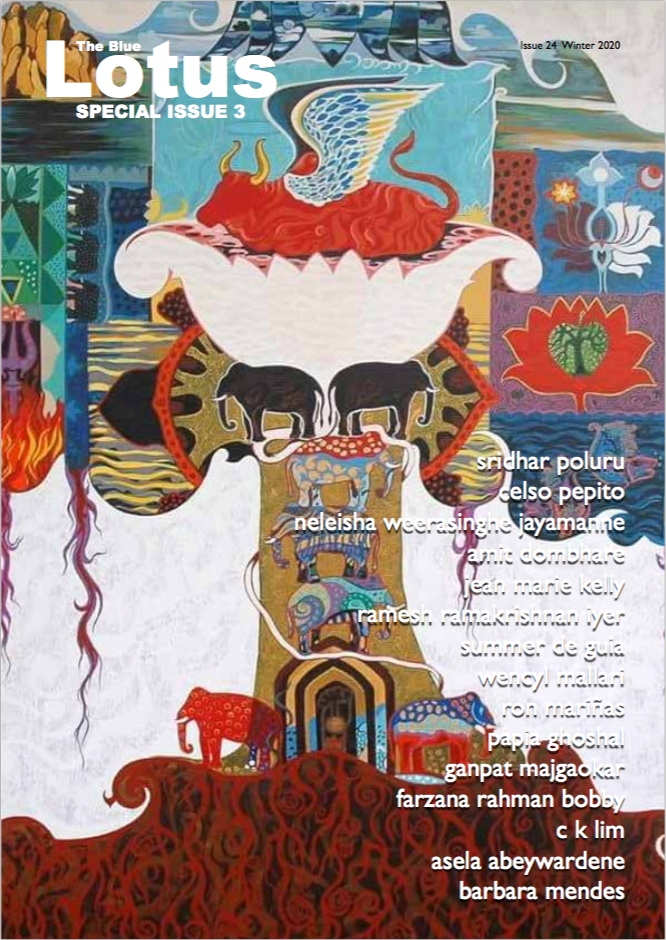
https://issuu.com/martinabradley/docs/the_20blue_20lotus_20magazine_20special_203

I sit here (in Cambodia), awash with sounds of the gamelan, as the Director of the 17th Asian, African & Mediterranean International Modern Arts Exhibition, Luo Qi (China’s foremost exponent of Calligraphysm and Characterism), sits in Portugal and many of the artists featured in this new online exhibition sit in their respective countries, or are displaced and awaiting passage home. My sky is blue. Sunlight streams gently through my apartment’s open door. There is a slight breeze rustling the bamboo. White butterflies dance of joy.
In other times, this truly cosmopolitan exhibition would have had a splendid physical presence.
For sixteen years, and from divers countries, artists have gathered in places including Luo Qi’s Chinese hometown of Hangzhou, China. While these exhibitions have always been international, the move to digital has allowed many more artists to participate. This time there are participants from Australia; Bangladesh; Brazil; Bulgaria; Canada; China; France; India; Indonesia; Iran; Italy; Japan; Korea; Madagascar; Malaysia; Mauritius; Mexico; Morocco; Nepal; Philippines; Portugal; Serbia; Seychelles; Singapore; Slovenia; Thailand; Togo; Sri Lanka, United States of America, and Vietnam. The artworks of those chosen artists are open to the world, and not just to be seen by cultured art aficionados, but rather any, and all, intrigued and fascinated faces.
In the past artists had to physically create their exhibitions. Stepladders erected, drills, Rawlplugs and all the other paraphernalia of exhibition making would have been at hand, and busy in hands erecting not just their own but each others creations. Camaraderie, sheer joie de vivre and all the wonders of team spirit had been naturally sparked during the coming together of the exhibitors, the exhibitions, and their audiences echoing the overall meme of international cooperation, engendered by Director Luo Qi.
This year (2020) is slightly different.
In many senses Luo Qi is a modern day Chinese Admiral Zheng He. Like the famous, (or is that infamous) adventures of Homer’s Odysseus or the seven voyages of Zheng He (ambassador and explorer), Lou Qi has navigated his way to countries near and far. In now seventeen ‘voyages’ Luo Qi has collected not giraffes and jewels, but merchandise far more precious – world artists and their art. Instead of physically sailing the seven seas, this year Lou Qi has ‘surfed’ the World Wide Web. Ever expanding his horizons, Lou Qi has set his sights on a global Internet collaboration of artists and brought together over one hundred artists, of whom seventy plus have been chosen to celebrate the 17th (annual) Asian, African & Mediterranean International Modern Arts collaboration, in an online exhibition.
Luo Qi asked me to commit to the momentous task of commenting on some of the works on show for the exhibition. Of course I was not able to write about all, so you have my apologies for that. I was full of mixed feelings and mixed loyalties, for I have known some of the participants and have enjoyed their artworks over many years. I struggled with impartiality and ultimately wrote down the names of those artists whose work connected with me most, as I scrolled through. I hasten to add that the situation I found myself in was to choose a ‘first among equals’, an impossible task; however I will mention those artists I did choose and the works that I was particularly struck by; in country alphabetical order.
China
Shi Jianguo creates using coloured inks on paper. He depicts (largely) emancipated female qipao (cheongsam) wearing graphic ‘characters’. They have the distinct appearance of stepping out from circa 1930’s Shanghai, with all the cultural visual ambiguity that might entail. The rouged lips of these socialite or upper class women are often pursed, sometimes wantonly smiling and frequently obscured by elongated fingers holding cigarettes. Shi Jianguo’s works are splendid caricatures that, in another age, might have been seen in Chinese magazines such as Modern Sketch or considered as a pastiche of images in the magazine (Liángyǒu) The Young Companion which reflected Shanghai’s growing colonialist cultural identity.
Zhang Fangbai, one of China’s modernist calligraphers, usually specialises in the depiction of birds of prey however, in these three innovative paintings he presents a literal ‘bird’s eye’ view of the ancient traditional of Chinese landscape. In these images Zhang Fangbai re-perceives notions of the art of Chinese ink brush painting by using the synthesis of a more modern Western approach of painting with oil on canvas and ideas inherited from ink brush tradition. The three canvases presented are a reverential salute to the past while simultaneously being an acknowledgement of China’s modernity and unification with Western and Eastern ideas.
India
Maitreyi Nandi’s exquisite artworks, which to some in the West may appear to illustrative, follow a distinct modernist path set down by India’s premiere modern artists such as Jamini Roy and Gaganendranath Tagore, who referenced local Indian visual folk traditions to present their own brands of Indian ‘Modernism’. Maitreyi Nandi paints (often) seductive, positive, images of the plight of women. Some enlightened women are depicted within the Hindi mythos as goddesses, or mothers in frequently glowing representations of Indian fables. Maitreyi Nandi follows in the footsteps of pioneering female Indian artist such as Amrita Sher-Gil, Pratima Devi and many others.
Italy
Marcello Schiavo’s delicate yet intriguing watercolour landscapes are somewhat reminiscent of the Impressionists’ works in the way they are able to both capture light and our imagination. His ethereal touch graces his substrate and our vision. There is a hint of a prayer to nature, or a meditation on nature in his light and airy works. His images enable his subjects to breathe, while his viewing audience must catch their collective breaths at his stunning portrayals. Marcello Schiavo’s works might be compared to those of England’s Joseph Mallord William Turner for, like Turner, Schiavo was a skilled draughtsman and an adept watercolourist.
Korea
Shin Young Ho is a surrealist inspired artist. He is also a most unusual modern Korean calligrapher, who specialises in rendering huge brush strokes, on paper. His chief meme is nature, specifically the minutiae of insects like ants and mosquitoes, painted large, as if seen under a microscope, some with black ink, or black ink and a colour wash. His well-defined ants seem very Dalian. Salvador Dali created images of ants in his paintings to represent desire and the decay he encountered as a boy in Catalonia. Shin Young Ho’s ants, though mostly black, sometimes occur as red against a grey wash, but are always stunning in their size and clarity.
Madagascar
Pierrot Men, is a photographing artist specialising in classical black and white photographic images. In his sensitive, yet outstanding, images of simple, humble people Madagascar people he rivals photographers such as Robert Frank and Daidō Moriyama, giants of photography. Images of the lives of ordinary Madagascans come alive through his lens in rich black and white, revealing not just the working lives of the people but the photographer’s intense love for them. Elsewhere his work has been likened to photographic poetry, delicate yet intense, for he has the keenest of eyes coupled with the quickness of thought to capture otherwise ephemeral moments.
Sri Lanka
Asela Abeywardene, is a ceramicist extraordinaire. Gaining inspiration from nature and the stillness of her religion, the artist has developed an organic approach to pottery that reflects the beauty as well as the tenuous nature of existence. As you might expect, coming from an island imbued with a long history of Buddhist, there is a Buddhist nature to her works as well as intimations of the sea. Delicate forms dripped or stroked with green, and as tentative as the leaves they echo, remind us of our fragile existence. There are hints of the best of Art Nouveau and Art Deco in her works, melding artistic creations East to West to produce her uniqueness.
Vietnam
Tao Huong delights in painting nature as well as engagingly colourful portraits (seen elsewhere). Seen here are three engaging landscapes full of energy and movement, yet each capturing a different moment and a different hue, reminiscent of the work done by Claude Monet with haystacks and the different aspects of light on Rouen Cathedral. Tao Huong’s works give depth for the viewer to sink into. In each of the paintings the hues are carefully balanced for harmony, yet of the three it is the brown landscape that has me transfixed by its intriguing perspective, and balance of warm and cooler colours.


For most people 2020 has been a difficult year. You would be forgiven for thinking that all is doom and gloom. It isn’t. In Kajang, a small ex-tin mining and ex-coffee estate town in Malaysia (known for its wide variety of ‘satay’), hope thrives. A fresh multi-ethnic enterprise is taking shape, fostering the eruption of broad smiles beneath the mandatory pandemic facemasks.
One Malay dictionary has defined the word ‘kajang’ as objects made from leaves of nipah, bamboo, mengkuang or palm leaves, used (traditionally) for roofing or for small hut awnings. Local indigenous tribes people (the Temuan) had explored the area now know as Kajang since16th century, and had discovered bamboo and palm leaves that they then folded to make roofing. Hence Kajang.
John OH founded Kajang Art Heritage. He is also founder of the Contemporary Malaysian Water-colourists’ Association, and a pioneer Malaysian artist, active in the early '90s. With friends of ‘Art’ he has provided a venue for creative people to connect and to share ideas globally. This idea has gestated. It is now delivering not just information and memories of the local past, but is also well on the way to engineering a Malaysian arts hub. In collaboration with Satay Putera Kajang, the Malaysian Advanced Photography Group’s April Chin, James Yuen, Irene Wan and Andy Chow with the " I am an Artist, I talk Art " initiative the notion of bringing art and arts to the general population has materialised. It leaps forward with Herculean bounds as the " I am an Artist, I talk Art " series of videos interviews glean attention from YouTubers internationally.
The antique shop-house offered to Malaysian Chinese artist John OH and the Malaysian Advanced Photography Group, has helped to explore ideas for possible creative usage. Gallery owners, writers, artists, artisans and collectors were all invited to participate in the idea of an eventual ‘art hub’ in Kajang, beginning with notions for a first exhibition to meld conceptions of craft and art. Next was to construct how to present this to the general public, and eventually expand to the reality of an ‘Art Street’. Mr OH mentioned “The main objective of this project is to create a platform for young and emerging artists to interact and dialogue with the public. Also to scout new talented artists in Malaysia.”
To develop this notion of art promotion, a coterie of artists were invited to take part and, within three days, eleven artists had confirmed their participation. Next contractors and interior designers were appointed to refurbish the two top floors (spread over two buildings), leaving the wonderful wooded floors and the single ground floor. Care was taken not to modernise the buildings too much but, with patches of exposed brick and plaster, enough of the originals were left to reflect the town’s heritage aspect.
Entrepreneurs worked with art friends to bring art and artists to the general public with the notion of a Kajang Art Heritage. The Malaysian Movement Control Order (MCO) enacted due to the raging pandemic, has prevented many career artists and other creative people from selling their work. Globally, and locally for Malaysians, art galleries have closed, presenting difficulties which online buying as not yet been able to solve. The idea was mooted to turn a two-storey 110-year-old former shop-house into an art gallery/workshop centre for artists and generally interested in culture, to meet, to exhibit, to discuss and to promote art and culture.
Despite the weighty pressure of the Covid 19 pandemic, or maybe because of it, Malaysians across the country rallied together in Kajang to promote heritage and a wide spectrum of the arts. Fine artists; craftspeople; photographers, cartoonists and one delightful cello player came together in the explorative exhibition - Merdeka Art Fest, shown over the period of festivities celebrating the country’s independence from Britain. That spectacular show, housed in the Kajang Heritage Centre (which incidentally serves fine coffee as well as fine art, and local satay as well as pyrography) was a great success, for over 3,000 people attended the displays, proving this enterprise to be a good springboard for the overall arts endeavour.
It is with thanks to the inspired and inspiring artists, the craftspeople and the photographers who not only created marvels to observe but readily gave up time and their creations for the first showing of that exhibition Merdeka Art Fest as well as with thanks to Kajang Art Heritage. Timed superbly for the week Malaysia celebrates independence and unity there was little doubt that such a visually appealing enterprise would be a success.
Countless individuals came together in the spirit of community to make the exhibition the accomplishment it was. As it was a fresh space, much time and energy was needed to prepare it to house creative works ready to interact with audiences. Walls needed preparation, creations needed hanging, and often re-hanging to achieve the desired effect, or fixing in the correct position to be observed. The marvel of exhibition creating is not just in the positioning of the work on show, but also in the coming together of a team capable to doing so. With so many experienced people involved with the enterprise it is not surprising that the exhibition, egged on by Malaysian Advanced Photography Group (which since has become ill named as in its widest of art briefs now caters to a wide range of creative people and not just photographers), has been so remarkable.
As the initial enterprise of a newly minted creation, the show, indeed, was a runaway success. That multitalented, multi-ethnic and multi-religious show brought creative people together with others who may not have had an inkling for ‘art’, but have gone away having an experience they could not forget. Even the playful younger members were able to join in, to interact, draw and paint, and perhaps in doing so absorb some of the creative atmosphere around them.
Now that the pictures have been taken down, the constructions moved and the cellist silenced, we all eagerly await the next outing.